Showing posts with label Spain and Portugal. Show all posts

Tuesday, August 20, 2013

An Unplanned Paella at the Food Bloggers Picnic

Paella  al fresco at the Bay Area Food Bloggers Picnic
What to take to the food bloggers picnic?
You want to show off, but not be obnoxious about it.
You want something portable and suitable for al fresco eating that shows you have game.
And most important when you are trying to decide on the morning of the picnic when you have done NO advance planning or shopping, you want to cook something you have all the ingredients for in the house.

My recent solution was a vegan paella.

You could make yours not vegan by browning ground animal-based chorizo (either take it out of the casing or try Diestel's excellent ground turkey chorizo).  Every brand of chorizo (even among the soy versions) has a different seasoning, so you may need to adjust the heat and salt in your paella. I used the Trader Joe vegan chorizo in this recipe. (Note: This recipe calls for the uncooked style of Mexican chorizo -- which is much more widely available in the U.S. than the traditional Spanish cooked chorizo sausage.)

Feel free to sub out the vegetables and garnish.  Paella is a very individual dish and is suitable for many occasions and virtually unlimited adaptations.  For the best paella, I do believe using a thin, seasoned metal paella pan (paellera) works best.  (Although I've made decent paellas in a stainless steel fry pan.) You also need the right rice.  Use either a Spanish paella rice (such as bomba or Calasparra) or Italian aborio rice.  I usually make mine on the stove and then finish it in the oven for even cooking, but if you have access to an outdoor fire (especially wood) it is wonderful cooked on that.

Here's my basic rules for paella making. I encourage you read through them since I give a lot of tips on how to make paella in the post. The post also features a recipe for paella with meatballs and avocado sauce. I've taken to serving my paellas with a sauce of some kind.  I like the avocado one in that recipe, but I've also made a smoked eggplant one and even used hummus as one.  They really elevate the taste experience by adding a creamy, cool component.  For this paella, I served a simple store-bought hummus for folks to drizzle over their rice.

I don't claim this is a "traditional" paella, I'm not sure I believe in such a dish any more, anyway.  A paella is just a canvas to express flavor and texture to me as long as it still relies on what I consider proper technique.  The one step I usually include that's not in this version -- I normally add chopped tomatoes to my sautéed vegetables.  I didn't here because I didn't have any regular tomatoes in the house due to my aforementioned lack of planning.

Since I started writing this my patron saint of paellas, Penelope Casas, has passed away.  Her books taught me the basics of technique and encouraged me to experiment.  I fell in love with Spanish food during my first trip to Spain in 1995.  Casas helped me recreate a little taste back home with authenticity and vision. 

A word of encouragement -- the directions are more complicated to write out then do (especially if you review by basic rules and read through the recipe posted there.)  Allow yourself enough time (paella holds beautifully) and enjoy.

Accidental Vegan Paella
Serves 3-4, more as tapas (appetizer)

2 cups vegetable stock
Pinch saffron threads (optional)
2 Tbs. oil
6 oz. crumbled soy chorizo (out of casing)
1 cup chopped onion
2 Tbs. minced garlic
1/2 cup chopped celery
1/2 cup chopped  carrots
1/2 cup chopped red bell pepper
1/8 tsp. or to taste salt
1/8 tsp. or to taste black pepper
1/8 tsp. ground cumin
1 cup paella or Arborio rice
1 cup white wine
About 16 green beans or asparagus spears, partially cooked
About 8 cherry tomatoes, halved
1/2 tsp. smoked paprika
Fresh, chopped parsley for garnish

Preheat oven to 350 degrees. Put stock in pan on stove and heat to simmer and add saffron threads if using.  Keep warm.

Add oil a 10-12" paella pan or oven safe sauté or fry pan. (See note below.)  Heat oil in pan on stove over medium high heat.  Brown chorizo.  Remove from pan with slotted spoon.  Add onion and sauté until softened.  Add garlic, sauté until golden.  Add celery, carrots and red bell pepper.  Sauté until beginning to soften.  Add salt, pepper and cumin adjusting to taste since chorizo is highly seasoned.  Sauté a minute, stir and mix in browned chorizo.  Mix well.  Add rice.  Stir until well coated with oil.  Sauté for a minute, add 1 and 1/2 cups stock and wine.  Mix well, and stir occasionally until stock is simmering and rice has begun to swell. Adjust heat to keep at a simmer.

From this point on, do not mix or stir the rice.  (Stirring makes the dish mushy as well as preventing the formation of a bottom crust of rice.) If you are concerned that it is not cooking evenly, adjust or rotate the pan on the stove over the heating coil or flame.  Place string beans and cherry tomatoes in a decorative pattern on top of paella.  Continue to cook, without stirring, until rice is beginning to soften and if you bite into a grain it is crunchy but not raw tasting.  (Timing will vary widely).  There should be some liquid left in the pan as well.  If the rice seems dry, add stock as needed.  (You will probably need to use the entire 2 cups.) If you use up stock, add warm water as needed. Cover with aluminum foil or pan lid.  Place in oven and bake for  10 minutes. Check to see if rice is almost but not quite cooked through when you bite into a grain.  If the rice is not ready, add liquid if needed, cover and check again in a few minutes. When the rice at that al dente stage, remove from oven and keep covered for 10 minutes or so before serving.  Uncover and garnish with chopped parsley.  If not serving right away, slightly undercook and keep covered until serving or uncover and serve at room temperature, garnishing right before serving.

Note:  You could use a larger paella pan, but timing will vary greatly.  If you are using a 14" pan, you could adjust the recipe to increase ingredients by 50 percent.  If you are not using a paella pan, make sure that any handles on the pan you do use are oven safe.  Heavy cast iron pans, earthenware casseroles and similar pans do not work very well in terms of getting a traditional paella texture.


Tuesday, February 21, 2012

Revisionist Meat Loaf. It's What's for Dinner -- Stuffed Cabbage Meat Loaf and Spanish Kale and Olive Meat Loaf

Stuffed Cabbage Meat Loaf
Meat loaf. Just saying those words seems to conjure a remembrance of a specific meat loaf recipe for most people. For many folks it’s family food, not something special for company, but meat loaf is too good to not get a chance to shine, so here are two untraditional meat loaf recipes to try.

The Stuffed Cabbage Meat Loaf started with my memories of my Eastern European Jewish grandmother’s meat loaf and her stuffed cabbage. In her honor, the meat loaf has a hard-boiled egg core, a cabbage wrapping and a sweet and sour tomato sauce to top it off. This is a good recipe to use with low-fat ground beef, since the cabbage keeps the meat loaf moist.

The Spanish Kale and Olive Meat Loaf features Iberian seasonings and pimento-stuffed olives.

Stuffed Cabbage Meat Loaf
Serves 6-8

6 large, green cabbage leaves
Oil spray
1 1/4 lbs. ground beef
1 cup matzo meal
1 egg, beaten
1 14oz. can diced tomatoes with liquid
1/2 cup finely chopped onions
2 tsp. minced garlic
1/4 tsp. salt
1/4 tsp. ground black pepper
1/8 tsp. ground dried oregano
1/8 tsp. paprika
2 hardboiled eggs, shelled

Preheat oven to 350 degrees. Immerse leaves in pot of boiling water, cover, reduce heat to a simmer and cook 4-5 minutes until the leaves are pliable. Drain. Spray large baking dish with the oil spray. Lay 2 largest cabbage leaves stem end to stem end in the center of the baking dish. Set aside.

Combine meat, matzo meal, beaten egg, tomatoes with liquid, onions, garlic, salt, pepper, oregano and paprika. Mound half into an 8”x4” loaf in the middle of the 2 cabbage leaves. Press hard-boiled eggs into loaf end to end. Mound remaining meat on top. Drape 2-3 cabbage leaves over top of meat loaf, filling in gaps with remaining leaves. Fold up cabbage leaves from underneath to enclose. Spray top with oil spray. Bake, spraying cabbage with oil if it begins to dry out or get too brown, for 1 1/2 to 1 3/4 hours, until firm to the touch and cooked through. Let sit 20 minutes before serving. Serve with sauce (below).

Sweet and Sour Sauce: Plump 1/2 cup raisins in hot water for 20 minutes, drain. In a small pan combine raisins with 15 oz. can tomato sauce, 1 Tbs. brown sugar, 1/4 tsp. dried ground ginger, 1/8 tsp. salt, 1/8 tsp. ground black pepper and 1/4 cup apple cider vinegar. Simmer, stirring occasionally, for 10 minutes. Taste, adding sugar or vinegar as needed.

Spanish Kale and Olive Meat Loaf
Serves 6

2 Tbs. oil plus additional for greasing pan
1/2 cup chopped red onion
4 tsp. minced garlic
2 cups chopped kale or chard
1/4 tsp. red pepper flakes
1 tsp. smoked paprika
1/4 tsp. ground cumin
1/4 tsp. salt
1/4 tsp. ground black pepper
1 lb. ground beef
2 Tbs. tomato paste
2 eggs, beaten
1/2 cup bread crumbs
10 queen-size, pimento-stuffed green olives, cut into fourths

Preheat oven to 350 degrees. Heat 2 Tbs. oil in pan. Sauté onions and garlic until lightly browned. Add kale, red pepper, paprika, cumin, salt and pepper. Sauté until cooked. Oil an 8.5” x 4.5” loaf pan. Combine kale mixture with beef, tomato paste, eggs, bread crumbs, and olives. Put into loaf pan. Bake for 45 minutes to 1 hour until firm to the touch and cooked through. Let sit 20 minutes before serving.

----------------------------
Originally featured in j weekly.  Also featured on About.com's Eastern European food guide.

Friday, July 09, 2010

World Class Tortilla de Espana for World Cup Finals

Looking for something to serve at the World Cup final between Spain and the Netherlands?
Try this Spanish open-faced omelet called a Tortilla de Espana, especially if you are a supporter of the Spanish soccer team. (I guess if you want to be less partisan you could add some Gouda cheese to the recipe.)  My version relies on really, really good potato chips instead of the sliced and fried potatoes that are traditional.

This is more a procedure than a recipe, per se, so feel free to adapt and make it your own.
What happened to the photo of this dish?  Why, it was red carded. (Actually, I forgot to take it. I'll post one next time I make this.)

Tortilla de Espana
Serves 4

Be sure to use sturdy, artisan or homemade style chips for this recipe. Try making it a tortilla de tortilla by substituting high quality tortilla chips. The recipe works well for brunch or as a light entree, first course or appetizer or tapas (cut into small wedges).

1 Tbs butter
1 Tbs olive oil
1/2 small onion, thinly sliced
2 garlic cloves, minced
2 red peppers, seeded, thinly sliced
6 eggs, beaten
Salt, pepper, oregano, hot pepper flakes or hot sauce to taste
4 oz. salted or lightly salted potato chips (I recommend kettle cooked with ridges)
Smoked or regular paprika,  hot or sweet
Parsley, chopped, for garnish

Heat the butter and oil together in an omelet or small saute pan.  Saute the onions until light brown and add garlic and peppers.  Saute until onions and peppers are soft.  Remove peppers to a bowl and let cool. Add eggs and seasonings. Mix well. Gently fold in potato chips.

Reheat pan and add more butter/olive oil if needed.  Pour egg batter into the pan and cook until bottom of eggs are lightly brown and the top just set. Slide or tip the omelet onto a plate, so the browned side of the omelet is down. Turn the plate into the pan so the browned side is now up and cook until the bottom of the flipped tortilla is golden brown.  Turn out of the pan and serve hot, warm, room temperature or even cold, sprinkled with paprika and garnished with the chopped parsley.

Thursday, January 15, 2009

All Atwitter -- Spanish Stuffed Peppers with Smoked Paprika Tomato Sauce

I literally threw this dish together last night and haven't been able to stop twittering about it, it was that good.

I had to recreate the recipe afterwards, so some details are a bit fuzzy, but it is a very flexible concept based on what I had in the house -- no special shopping trips were made for this dish. So feel free to make your own substitutions.

I recognize where some of the concepts came from -- my sister's Cuban picadillo, my penchant for stuffing vegetables, my love of Spanish food, an interesting bag of mixed grains from the pantry and a half bunch of spinach from the fridge, but honestly, the dish came to me out of nowhere when I was in the mood to just cook not cook for the blog. While the dish was coming together I realized it had potential, so I did take its picture.

Spanish Stuffed Peppers with Smoked Paprika Tomato Sauce

Serves Four to Six

The ground turkey filling has a wonderful, warm, full taste and is good on its own without being stuffed in the peppers if that is easier or more practical for you. (Or if you have leftover filling after you have stuffed the peppers.) The tomato sauce adds a nice smoky note. Use regular paprika if you don't have the Spanish smoked paprika. It will still be delicious. The recipe took me about 45 minutes start to finish, but my grain mix cooked in 10 minutes. Allow more time if you are using brown rice or other long-cooking grain.

Don't be intimidated by the lengthy list of ingredients or instructions. It really is relatively easy and very impressive. The flavors of the dish really did remind me of the foods I've eaten in Spain. While I put this together for a family meal, I think it would make a nice "company" dish.

For a vegetarian version, try with lentils, white beans, veggie soy ground "meat" or crumbled tofu instead of the ground turkey.

Peppers

6 small to medium red bell peppers, "lids" cut off and reserved, seeded and cleaned
2 tbsp olive oil
1 small onion, chopped
2 garlic cloves, minced
1/4 tsp red pepper flakes, or to taste
1 tsp cumin
1 tsp sweet paprika (regular, not hot or smoky)
2 carrots, chopped
1 celery stalk chopped
20 ounces of ground turkey
1 cup diced tomatoes (I used canned, drained)
1/2 bunch of fresh spinach, chopped
1/3 to 1/2 cup pitted green olives, chopped (I used the kind stuffed with pimento)
1 cup cooked grain(s) -- I used a mix that included Israeli couscous and other grains. Regular couscous, bulgar, brown or white rice, millet or a tiny pasta such as orzo would also work.

Sauce

8 ounce can of plain tomato sauce
1 cup diced tomatoes
1 tbsp olive oil
1 tsp Spanish smoked paprika
1/2 tsp sugar or to taste
salt and pepper to taste

To serve:
2 cups of cooked grain (see comments above)

Stand the red bell peppers up on their bases in a microwave safe baking pan. Slice a bit off the bottom of any of the peppers that wobble. (Reserve scraps with reserved pepper tops). Put a half cup of water in the bottom of the baking dish and microwave on high for about 5-8 minutes or until the pepper shells are tender but not mushy. Drain water out of dish. Set peppers aside in baking dish.

Trim the leftover pepper "lids" and chop any usable red pepper. Chop any scraps cut from the bottoms of the peppers. Reserve.

Heat oil in large skillet. Saute onions until just golden, add garlic and saute until it begins to color.
Add red pepper flakes, cumin and paprika. Saute for a minute until they release their aromas. Add reserved red pepper scraps, carrots and celery. Saute for a few minutes until the vegetables begin to soften. Add the ground meat, breaking up any big clumps, and brown well, stirring often. When the meat is almost cooked through, add tomatoes and spinach, cook, stirring occasionally until the spinach has wilted. Add chopped olives, stirring well to combine. Cook until meat is cooked through. Add the one cup of cooked grain. Stir well to combine. Taste and add salt and pepper to taste. Stir well. Set aside.

Make the sauce. In a small saucepan combine tomato sauce, diced tomatoes, olive oil and smoked paprika. Stir well and cook until heated through. Taste. Add sugar, salt and pepper to taste. Stir well. (The sugar balances out the acid in the tomato sauce. Some brands need it, others don't, so taste first.)

Assemble the peppers. Stand the peppers in a microwave safe baking dish and using a large spoon pack full of the ground meat mixture. Spoon some of the tomato sauce on top of each pepper. Microwave on high for 5-10 minutes or until the peppers are heated through.

Reheat sauce and cooked grain if necessary. Serve the peppers with the cooked grain and remaining sauce.

Friday, June 27, 2008

Euro Soccer Championships

Any one else have a household following the European soccer championship games?
The big finale is this Sunday and it is Germany vs. Spain. My guys are talking soccer, I'm talking menu. Watch this space for what I whip up. Got some ideas for me -- either based on German or Spanish food traditions -- leave a note below.

Update: The game has just started! I decided on an unconventional tortilla espana made with potato chips. I've made it before and it was great! I'll post some pix and directions later. Now, back to the game.

Tuesday, June 10, 2008

10 Days in Barcelona

It’s been more than eight years since I spent my 10 days in Barcelona, but the city still holds me in its thrall. How can you not fall in love with a city (and environs) that offers architecture, art, shopping, history, natural beauty, good food, entertainment and a vibrant street life? Not to mention reasonably priced sparkling wine and hot chocolate as thick as pudding.

Because I have some friends going to Barcelona in a week or so I thought I would share some of the highlights of my trip. I don’t intend for this to be an all encompassing guide since my trip was so long ago, but I thought it would give a good taste of the city.

My favorite plaza was Placa de Pi. It and the adjacent Placa de Sant Josep Orial were ones we went back to time and again. There were pleasant outdoor cafes, a good restaurant (El Pi Antic) with wonderful grilled vegetables, mussels and crusty bread which was washed down with great cava (Spanish sparkling wine). The placa was in the Barri Gothic (old town) and an easy walk from our hotel. We went back several times enjoying the street performers and later in the week a cheese and honey market and then an art market.

The Barri Gothic was always exciting to walk through. The juxtaposition of those ancient buildings, new street sculptures the city had scattered about and the mix of tourist and traditional stores meant there was a surprise at every turn. This is not a museum district; it is part of the living city. Balconies, cobblestone streets and ancient architectural details made me feel like I had stepped back in time, although the graffiti and overheard cell phone conversations usually snapped be back to the present pretty fast.

La Rambla is a long boulevard connecting the Placa de Catalunya with the waterfront and the monument to Christopher Columbus. A wide green swath with sidewalks is in the middle of it. Each section bears a different street name and features different vendors ranging from magazines and books to birds. Street performers abound. It is colorful and very entertaining. I understand it was once the turf of those who tourists would do well to avoid but was cleaned up for the 1992 Olympics. It was a safe and exciting place filled with locals promenading and visitors snapping pictures of the human statues and the like and the scene there seemed to go on long past midnight.

Walking along La Rambla to Placa de Catalunya you could find a few of my favorite Barcelona stops – Boadas cocktail bar, La Boqueria and El Corte Ingles.

Boadas is a cocktail bar dating from the 1930s. Inside is all dark wood and Art Deco. Each day a different classic cocktail is on special and to watch the bartenders shake, stir and pour your libation is to watch poetry in motion. The cocktails were some of the best I’ve had anywhere.

La Boqueria is Barcelona’s famed public market. It was undergoing renovation when I was there, but even with just half of the market open it was truly awe inspiring. Besides assortments of beautiful fruits and vegetables and the like, the market has lots of prepared food ideal for a take away meal.

El Corte Ingles is my favorite department store in the world. I’ve been to ones in Lisbon, Madrid (several branches, two different trips) and Seville. Besides the excellent department store shopping, it boasts reasonably priced, good quality souvenirs and a wonderful food hall (although with La Boqueria near by, I would make that my food shopping priority in Barcelona).

Getting around Barcelona is fairly easy by metro and bus. It is an easy city to walk. There was also a tourist bus that connected most of the famous sights for a flat fee run by the city. You could buy multi-day tickets and get on and off as much as you liked. Information and tickets were available at the very helpful tourist information storefront near the Placa de Catalunya.

Modernista architecture is one of the qualities that makes Barcelona so special. Gaudi is the most famous of these Art Novueau architects. Casa Mila, Sagrada Familia and Parc Guell are worth a trip to Barcelona on their own, but other architects have left buildings as elaborately decorated as wedding cakes around the city. My favorite of the others is the Palau de la Musica (try to go when you can take a tour inside.) Be sure to seek out the little snack bar at Parc Guell, on top of what was to have been the market place, built into a cave near the undulating mosaic benches. Enjoy an orange bitters soda along with the view.

Barcelona has many fine museums, too many for me, even with my 10-day stay. My favorites were the City Museum with its Roman ruins and the Maritime Museum, with its recreations and Viking ship. I was left unimpressed by the Picasso Museum, although I know plenty of people who claim it as a highlight of their trip. When I was there the exhibits were Picasso’s student works and his late-in-life erotic drawings. The palace the museum is housed in is wonderful and the district around it was filled with interesting shops and boutiques and my favorite cava bar – El Xampanyet. Besides the sparkling wine, the bar also served hard cider and a wonderful assortment of seafood tapas.

Speaking of tapas, there are many places to enjoy them throughout the city. Often the tapas are on display through glass counters which makes it easy to point to what you’d like if you are shy about trying to communicate or uncertain exactly what’s in a dish.

I didn’t have a bad meal in the city. My most impressive was at the beautiful (and expensive) Jean Luc Figueras. This was years before I had even heard of a food blog, so I’m sorry to say there are no photos of the food or even any descriptions of what I ate that night. It was wonderful will have to do. It was also the first place I ever had a chocolate lava-style cake. (Trust me to remember about the dessert.) The restaurant is now known as Kresala and still garners raves for its tasting menu.

I stayed at Le Meriden, right off La Rambla. Walking across La Rambla let me straight into the Barri Gothic. Walking the other way took me into a district that reminded me of New York’s Soho in the 1970s and early 1980s – a gentrifying arts district. I set out in search of a horchatateria (a restaurant featuring horchata, a drink made from almond-tasting roots), but the drink was not in season and I settled for a wonderful milk and lemon fizz. I’m still trying to figure out how that concoction could exist without curdling in the glass or later in my stomach.

There was so much I was impressed with, I couldn’t begin to list them all , but here’s a few things I didn’t find worth the effort: the flea market, the Poble Espanyol (supposedly a collection of Spanish villages from all regions), and the arts and crafts market at the base of La Rambla.

Among the must sees is the weekly performance of the sardana. Every Sunday at noon, locals gather to participate in this folk dance at the base of the cathedral. (I understand there is also a sardana assemblage on Saturday at 6:30 p.m., but I didn’t go then.) An orchestra plays, women tie on espadrilles for the dance and tourists and passersby are encouraged to join the circles of dancers. You can watch from the cathedral steps are you can join in. Either way it gives you a feel for the vibrant connection that people of Catalonia have for their culture and past.

Another way to understand this link is to visit Montserrat which houses the Black Virgin, sacred to most Catalonians. There is a monastery with a boys’ choir, an art museum, a funicular to go to the top of the mountain and wander among the paths of the national park and perhaps visit some of the hermitages scattered through the rocky mountainside. There is a wonderful art museum, a cafeteria, a great bakery featuring “rocs” which are giant meringue cookies filled with hazelnuts, and a large gift store featuring everything from religious items to camping supplies. The site played a significant role in several wars but what held the most power for me were the bins and bins of items donated to the church in honor of promises made to the Black Virgin for her intervention. (There are buses directly to Montserrat, but another option is to take a train to an aerial cable car and get to Montserrat from Barcelona that way.)

Another side trip I would recommend is to the beautiful wine making regions. I went to cava country and toured Codorniu. If you don’t have a car, the train stops right by the Frexienet winery.

I also enjoyed a day trip to the Costa Brava. I was able to take a boat along the coast from Blanes to Tossa de Mar, where I had lunch at the edge of the Mediterranean and bought my beautiful yellow and green traditional mortar and pestle from a local shopkeeper (who was the nly person I came across in Catalonia who seemed to speak exclusively Catalonian). Both Blanes and Tossa de Mar are accessible by train and commercial boat trips are available during the summer along the coast.

I also went to Girona, which I enjoyed, with its riverside old town and shopping district, cathedral and call (Jewish quarter). That same day we went to Figueres to see the Salvador Dali Museum. The museum works best if you think of it almost like an installation of performance art. Is it worth a special trip? I didn’t think so, but if you are going up to Girona anyway and you are a fan of Dali and/or the absurd it is well worth the extra time.

Back in Barcelona, ask your concierge to help you find out about local nightclub shows. Featuring popular songs sung in Catalonian with half-clad showgirls, minimal plots and an audience filled with what appeared to be happy French middle-aged businessmen, it was an evening harkening back to what my vision of the Stork Club and other famous nightclubs must have been like back in the day. I went to the Barcelona City Hall nightclub, but there were a number of others. You don’t need to understand the language to understand what’s going on – it’s a good time, shared by all.
-------------------------------------
I no longer have the links to the websites I used to plan my trip. But here are a few I found you might find helpful:

I didn’t find an English link to the Barcelona City Hall nightclub, but from what I did run across it might now be a venue for assorted contemporary music concerts. I hope some of the nightclub culture is still there in Barcelona, it really was very special.

There is so much more I would love to share. Maybe I’ll do another post about Barcelona sometime. In the meantime, as always, please feel free to use the comments section to add your suggestions, updates and links.
--------------------------------------------------------------
Photo to come: This trip was pre digital camera; I have to scan some pix in!

Sunday, April 23, 2006

Potatoes (and Potato and Greens Soup) in Portugal

One of the biggest culinary revelations I had in Portugal was the wonderful, nutty taste of the Portuguese potatoes. Somehow the potatoes there just have a bigger, fuller, potato flavor. You (or at least I) could have made a meal just from the potatoes.

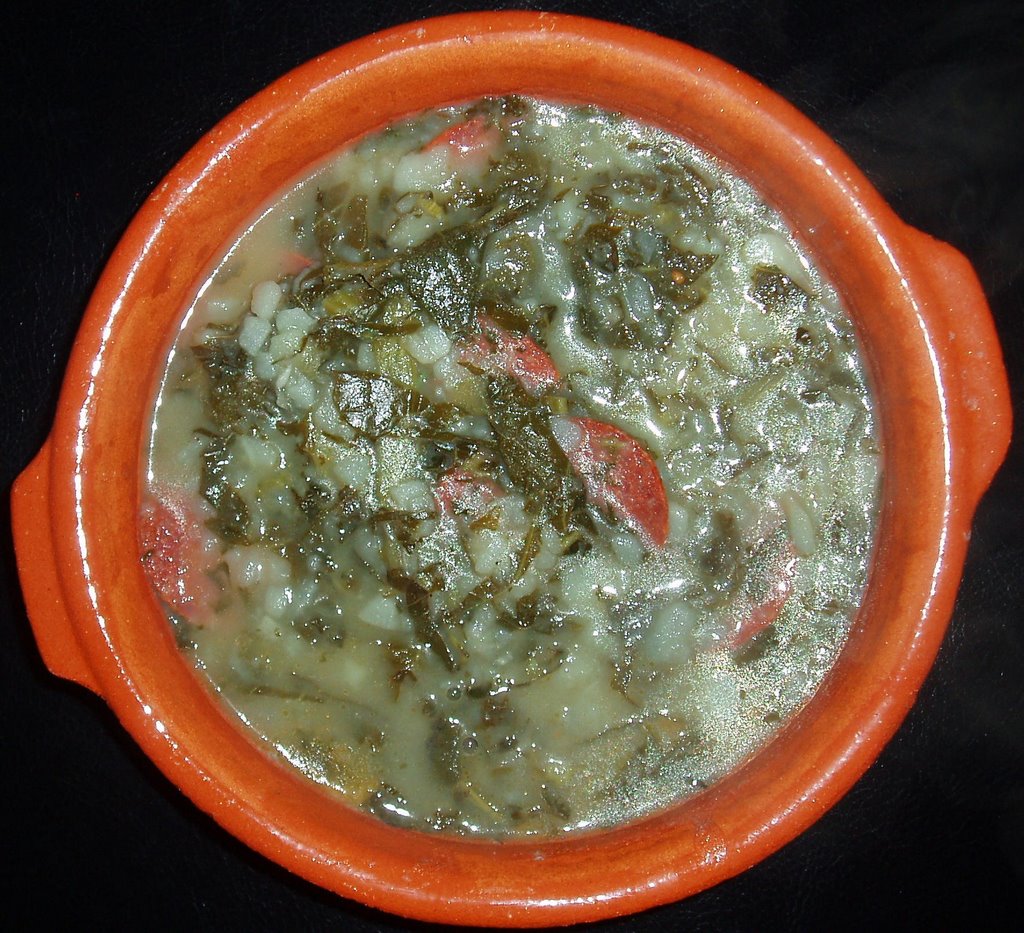
The closest I could describe the potato taste is that of a freshly dug, organic Yukon gold or yellow finn. Buttery, rich and satisfying. Lucky for me, big slices of boiled potatoes were the side dish of choice for many dishes. Potatoes are also the main ingredient in the famous Portuguese soup, Caldo Verde. It is basically water, potatoes, olive oil, Galician cabbage and seasoning. Some books describe it has having a garlicky sausage sliced in (and I've made it that way) but in Portugal I was never served Caldo Verde (Green Soup) with it.

Because our potatoes are not as flavorful as the Portuguese, I've adapted the recipe from Jean Anderson's comprehensive The Food of Portugal cookbook to reflect my recent experiences with the soup in Lisbon and Porto as well as making it here at home. (The book is available from the always dependable Iberian resource The Spanish Table.)

Be sure you pick a potato that will mash well. Anderson recommends an Eastern or Maine potato, which is probably like an Idaho or Russet.

Caldo Verde
Makes 6 to 8 servings

1 large onion, chopped fine
1 large garlic clove, minced
4 tablespoons of a flavorful olive oil (divided) -- try one from Spain or Portugal if you can. You want something with a bit of a bite to the flavor
6 large potatoes, peeled and sliced thin
1 quart water
1 quart vegetable or chicken stock
6 ounces thinly sliced dry garlicky sausage such as chourico, chorizo or pepperoni, optional. (I used turkey pepperoni in the version pictured above. You could also try one of the new soy sausage products.)
2 teaspoons of salt, divided (more or less to taste)
1/4 teaspoon freshly ground pepper (more or less to taste)
1/4 teaspoon dried red pepper flakes, optional
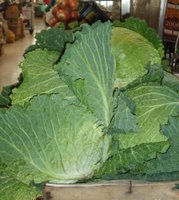
1 pound mixed sturdy greens. To replicate the flavor of Galician cabbage (see left) I used half collard, half kale. You could also use some turnip greens. The greens should be washed, trimmed of thick stems and veins and sliced into thin threads. (I rolled the greens into bundles and fed the bundles through my Cusinart using the slicer blade. It worked well and takes longer to explain than do! Just make sure your shreds are what Anderson calls "filament" thin.)
In a heavy soup pot, heat three tablespoons of the oil and then add onion and garlic. Saute for a few minutes over medium heat until they begin to color. (Anderson advises being careful not to brown them since that will make the soup bitter.) Add the potato slices and saute, stirring for two to three minutes until they too begin to color. Add the water and stock, cover and simmer until potatoes are very soft, about 20 to 25 minutes.

If you are using the optional sausage, prep the slices while the potatoes cook. Fry the sausage slices in a skillet over low heat until most of the fat is cooked out. Drain on paper towels and pat to get off excess fat.

When the potatoes are soft, take the pot off the burner and use a potato masher to mash the potato slices right in the pan. When the potatoes are as smooth as you can make them, add the optional sausage, half of the salt, all the black pepper and the optional red pepper, put the pot back on medium heat, cover and bring back to a simmer. Simmer for about five minutes. Add in the sliced greens and cook uncovered until the greens are tender (about five minutes). Add in the last tablespoon of olive oil and taste to adjust for salt and pepper. Depending on how salty your chicken stock is you may or may not need to use the last teaspoon (or even more) of salt.

Serve with a nice crusty bread and perhaps a little hot sauce on the side for those who like their food a bit more spiced. Tabasco is fine, but try to find a sauce made with piri-piri, small Angolan peppers which are the hot stuff of choice in Portugal.

Bom proveito!

Friday, March 31, 2006

Flavors of Spain I Adore You -- A Paella Variation

There are many reasons to go to Spain -- the people, the sights, the art, the music, the lifestyle, the shopping and the architecture -- but for me the compelling reasons always come down to the food. True, I travel the world on my stomach, but there is something special about the food in Spain. The paellas, the tapas, the chocolate. Lots of good things. I have lots of notes to turn into recipes and photos to download from my camera, most of which I haven't yet dealt with.

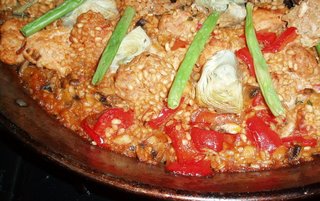
Within two days of coming home, before my jet lag had lagged, I already craved the flavors of Spain. So much so I had to make a paella for dinner. (The photo above is of my paella creation.) I adapted this recipe from a vegetarian paella I had in Madrid and several cookbooks, but I also was trying to use up some odds and ends from the fridge. There is no one kind of "correct" paella, but I do have some rules for paella making:

1. Use a Spanish short grain rice. There are lots of good kinds of rice from Valenica and other areas of Spain. If they are unavailable, use a Italian risotto rice such as aborio. You need a rice that will absorb a lot of flavor and give off a creaminess. If you don't have the right rice you don't have paella. You can make a lovely arroz con (rice with) whatever, but it won't be paella.


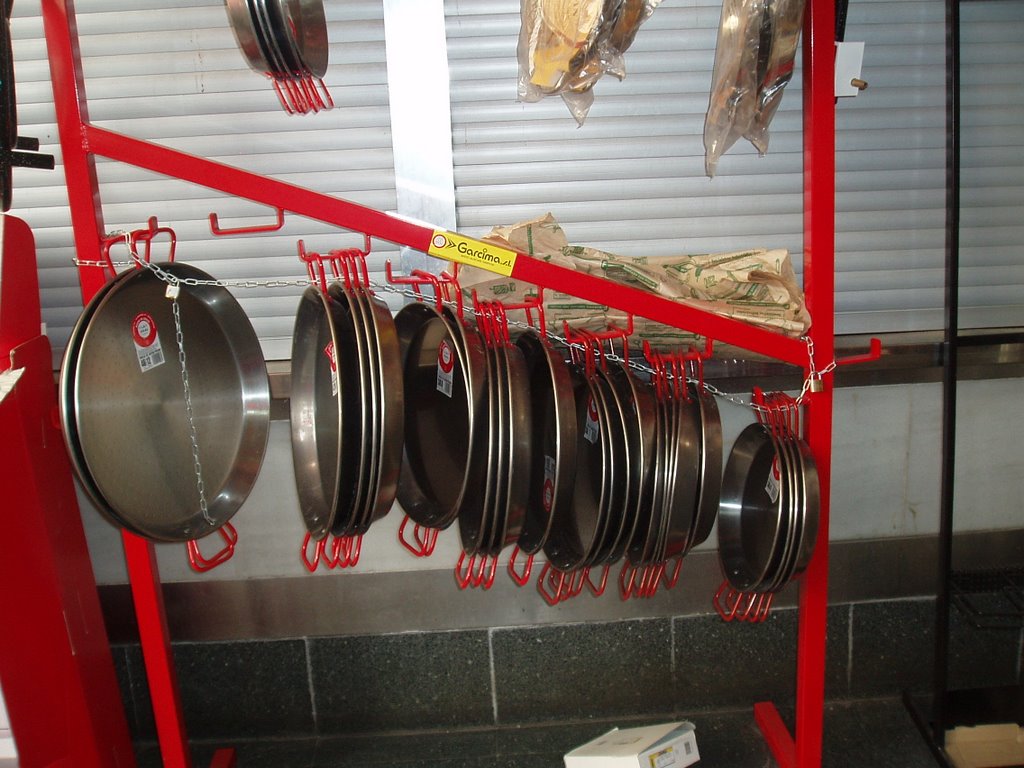
2. Invest in a paella pan. It doesn't need to be fancy. The shape allows you to brown your ingredients without crowding and helps the rice absorb the liquid correctly. If you don't have a paella pan, choose a pan that is wide and somewhat flat that can go into the oven and that is made out of a material that heats up quickly and cools down fast. Stainless or carbon steel are good choices. (The photo at left is of paella pans for sale in a Madrid market.)

3. Cooking a paella is a variable experience. You need to bite into the rice to judge where it is in the cooking process, don't just go by the clock. You need to gauge the soupiness of the broth. I can give you times, but it there are so many factors it is better to know what it is supposed to be like rather than depending on my telling you cook five minutes. Your rice may absorb liquid faster or slower than mine and you can end up with too much liquid in your paella or dry, tasteless rice.

For rice, pans and seasonings, I recommend the Spanish Table website but there are lots of other gourmet sites and stores that sell them, too. The following has been based on my own experience and ideas as well as recipes from Paella by Penelope Casas and The Spanish Table by Anya von Bremzen. Both books are available from the Spanish Table, although the book and website are not affiliated.

Paella with Meatballs and Vegetables with Avocado Sauce

For meatballs
3/4 pound of ground turkey meat
2 tablespoons finely chopped parsley
1 clove garlic, finely minced
3 tablespoons of finely crushed bread crumbs
1 egg, beaten
2 tablespoons water
ground pepper to taste

Combine ingredients. Form into 1 inch meatballs. Set aside. (Can be made ahead and refrigerated, bring to room temperature before using.)

For broth
4 cups of homemade or good quality commercial chicken broth
10 cloves of garlic without peels
2 tablespoons of paprika, preferably Spanish smoked style
2 springs of parsley
1 dried sweet pepper, Spanish noras, mild New Mexico pepper OR 1 fresh red bell pepper, seeded and cored and cut in half
pinch of saffron threads
2 tomatoes, chopped

Combine all ingredients in sauce pan. Bring to boil. Simmer until vegetables are softened. Strain, pressing down on solids to extract liquids as much as possible. You should have three cups of broth. Add water or more chicken stock if need be to make up three cups. Return to a simmer to use in paella recipe. (Can be made ahead and reheated.)

For Paella
4 tablespoons olive oil
Small onion, chopped
6-8 cloves of garlic, chopped
1 red pepper, seeded, cored, chopped
2 medium size tomatoes, chopped
1/8 pound of white button or small brown mushrooms, chopped
1 pound of boneless chicken thighs or breasts or combination cut into large, bite size pieces OR 1 pound of sweet turkey Italian sausage, sliced into rounds. (Or do a combination)
1 1/2 cups of paella rice (see "rules" above)
Broth (see above)
Meatballs (see above)
Coarse sea salt to taste
About 3/4 cup of cooked artichoke hearts
About 3/4 cup cooked green beans
Chopped parsley to sprinkle on top of finished paella (optional)
Avocado sauce (optional, see below)

Heat oil in a 12 to 14 inch paella pan (measured at it's widest point) or a wide, shallow fry or saute pan over a medium high heat. Preheat oven to 400 degrees.

Add onions, saute until slightly softened. Add garlic. Saute until golden. Add chicken and sausage and brown (cook in batches if need be to avoid steaming). Add red bell pepper, mushroom and tomato chunks. Saute for a minute. Add rice, toss to coat thoroughly in the oil. Saute for a moment, then pour in the simmering broth. Stir everything to combine, cook at a boil for about five minutes, stirring every now and then. Add in meatballs. Continue to cook uncovered on medium high heat for about five minutes more, stirring occasionally.

The rice should be absorbing the liquid as it cooks. Since the pan is bigger than your burner, you may need to adjust its positioning to make sure the rice cooks evenly. If the rice seems to be drying out too fast in a particular spot, add a bit of water or chicken broth to it.

Bite into a grain of the rice. It should no longer have a raw taste, but still have some resistance or "crunchiness" in the center. While most of the broth should be absorbed, there should still be enough in the pan to seem a bit soupy. Taste also for salt and add to your taste at this stage if it is needed.

(If your paella rice is not at this stage, continue to cook it on the stove top, testing a grain of rice every now and then until it no longer tastes raw but has a "crunchy" center as described above. Then proceed as directed below.)

When your paella is at this stage, arrange the cooked artichoke hearts and green beans on top of the rice mixture, then carefully move the paella pan to the center of the preheated oven and continue to cook for 10-12 more minutes, or until most (but not all) of the liquid is absorbed and the rice seems cooked ALMOST all the way through when you bite into a grain. You want a bit of resistance at the core of the grain. Good paella is not mushy!

Remove the paella pan from the oven, cover with aluminum foil and let set for 10 minutes more, or until grain of rice is cooked all the way through and the rice mixture is moist but not liquidy or dry.

Scatter with chopped parsley, if desired, before serving. Serve with optional avocado sauce.

Avocado Sauce

This very untraditional sauce is based on a tapas recipe from The New Spanish Table. A spoonful or two on each serving of the paella really adds a bit of bite and richness, punching up the flavor. I used a mortar and pestle I bought in a past trip to Spain to mash everything together. You could use a bowl and the back of a sturdy fork as a substitute. Do NOT puree this in the food processor, it will pretty much liquify.)

Mash together:
2 small garlic cloves, finely chopped
3 tablespoons minced fresh parsley
1/4 teaspoon of coarse sea salt

Add:
2 small avocados, preferably Hass, pitted and cut into small bits
1 small, ripe tomato, cut in half and grated(you only want to use the mushy, grated bits, discard the skin).

Mash with the other ingredients until a rough puree, then add:
1 tablespoon sherry or apple cider vinegar
2 tablespoons fresh lemon juice
1 1/2 tablespoons olive oil

Combine into a rough, slightly chunky sauce. Let sit about 15 minutes for flavors to mix. Taste and correct with additional salt and/or lemon juice as needed.

Thursday, March 16, 2006

Hi From Sunny Lisbon

I am writing this from Lisbon. Please forgive any typos since I am writing from an internet cafe with less than superior equipment and a Portguese keyboard.

I will not be posting very regularly during my trip, but I will try to check in.

Here is my first report:

This was written in my little travel notebook on the first leg of my trip to Lisbon and Spain. (Newark, here I come.)

The plane is pretty full, the seats are cramped and a baby is not so much crying but getting set off like a car alarm, sounding off for a period of time, resetting , and then setting off with the next stimulus.

I was actually served a hot mail on this flight, a rarity on transcontential flights these day. I meant to take a photo, but I realized too late the camera was in the overhead and I was trapped by the meal tray.

So imagine if you will a square plastic tray offering a samll white dish of fruit (2 red grapes, 3 oragne sections, 1 chunk of pineapple), a tiny, tiny muffin on indiscernable flavor, a cup of non-objectional raspberry yogurt and a steaming, clear plastic bag containing the mystery entree.

From a distance I couldn't make out what the flight attendents were plopping down to the pasengers in front of me. Needless to say, the entree looked better the further away it was from me.

About five rows away, I couldn't see, only smell.

"Something with eggs," I thought.

By three rows away I could make out the clear bag wrapping and make out a basic shape. A torte, a slice of quiche?

One row away, I could see it was scrambled eggs in pita bread. A sandwich. Okay, I thought. There's a lot of good things you could do with that.

Then it was my turn. I pulled apart the wrapping to discover rubbery pita and scrambled eggs. Nothing else. Just eggs and bread. No cheese, no veggies, no seasoning, no sauce to put on it, no nothing.

What I do? It was a long flight. I was hungry. In the tradition of generations of travelers before me, I just ate it, after liberally sprinkling it with the little packet of pepper that came on the tray. Oh, and think of how I would have made the same dish. I would have sauted some onions and veggies and scrambled the eggs with them as well as some cheese, seasoning (maybe cumin, maybe paprika, may French provencal dried herbs), and fresh herbs. And served some fresh salsa or similar on the side.

Eggstactly.