Monday, February 16, 2015
Call It a Pizza, Taco or Crepe, It is Still Vietnamese and Delicious
Sunday, February 15, 2015
Strawberries in Dalat
Saturday, February 14, 2015
On a Roll -- Lacy Vietnamese Spring Rolls
Friday, February 13, 2015
Nuts for Cashews
Tuesday, February 10, 2015
Iced Coffee by Dong Nai River
Thursday, February 05, 2015
Crisps (or Chips) Ahoy -- Lobster and Other Flavored Potato Snacks
Monday, May 25, 2009
Spring When It Sizzles -- Vietnamese Banh Xeo Pancakes with Greens
The Oakland Asian Cultural Center is sponsoring a series of Asian cooking lessons with the idea of passing on these traditional foods to those who might not have grown up learning all about Laotian fresh bamboo soup or Thai green curry from their parents or grandparents. The OACC classes (which are supported by the Alliance for California Traditional Arts) put the emphasis on eating seasonally as well. For more info about the classes and how to sign up, click here.The latest class was on Vietnamese Banh Xeo eaten with fresh greens. Taught by Thy Tran of Wandering Spoon, it was a hands-on class on this classic, which is sometimes known as sizzling or happy sounds crepe or pancake for the sound the batter should make when it hits the hot pan. (You can hear the sizzle and directions here from Tran's website.) For a slideshow featuring highlights of the class, click here.
Thy shared stories of her childhood, food experiences and her amazing mother, who taught her how to make this dish. She was determined to teach the process to us as she had learned it, by watching and then trying. She also passed on lots of tips that only experience can teach, everything from what products she found the best (see recommendations in the recipe) to tricks for peeling ginger and turmeric (use the side of a tablespoon).
Thy had us break into groups to make the rice flour batter from scratch -- from soaked rice. We added turmeric and scallions and ground the rice with water almost into a fine paste. Thy advised a little bit of grit for a better texture crepe. An acceptable option is starting with the pre-ground rice flour (look for Erawan brand with three elephants and be sure to get the kind with a red label) available from Asian markets. (To use it mix with ground turmeric, coconut milk and water until it is a creamy paste then proceed with the recipe.)
Then it was on to happy sounds; the sizzling of the crepe batter hitting the pans. Or, in some cases the not so happy sounds of students having to dump their batter out and starting over again because they used too much oil, too much batter or they started before their pans were hot enough. Thy had us frying in woks, an Indian dosa pan, a cast iron fry pan (class and Thy favorite), and a non-stick fry pan. The woks were the hardest to control, but created the most spectacularly large and golden crepes.
When the bahn xeo better was about half way cooked in the pan, we added our own combinations of cooked mung beans, stir fried pork and/or shrimp, and raw mung bean sprouts. Then we let the crepes cook until they were golden, the edges browned and a spatula inserted underneath could lift the pancake cleanly.
A quick flip of the spatula to fold the pancake in half, a slide onto the plate and it was ready for eating with dipping sauce and lots of Asian greens and red leaf lettuce. While there was a bounty of fresh greens around us, Thy was nostalgic for the really young and tender spring greens she has eaten these crepes with before, especially the ones her mother grows on her Midwestern property. We, her students, had to make do with the greens from the downtown Old Oakland Friday farmer's market (known for its Asian produce). It was a feast, and one we had all made for ourselves. We were the ones making the "happy sounds" as we devoured it all.
Here is the recipe from Thy that we used. I made a very few changes based on my notes, but the recipe is not mine. This recipe is copyright Thy Tran and is used with her permission.
Banh Xeo -- Vietnamese Sizzling Crepe
Recipe Courtesy Thy Tran, Wanderspoon.com
Makes about 8 crepes, enough for 4-5 when served with the Asian Vegetable Platter
Batter
2 cups jasmine rice, soaked in water at least 4 hours
1/2 cup of coconut milk (Thy likes Chaokoh brand)
4 scallions, whites only, chopped
1 inch turmeric root, peeled and chopped, OR 1/2 teaspoon turmeric powder
1 teaspoon salt
Filling
1 pound pork tenderloin, julienned or coarsely ground pork
1/2 pound whole shrimp, peeled (deveined if desired)
6 cloves garlic, minced
3 tablespoons fish sauce (Thy likes Three Crabs, Golden Boy or Flying Lion brand)
2 tablespoons vegetable oil, plus (lots) extra for cooking filling and crepes
Pinch of sugar
Freshly ground black pepper
1/2 cup dried split mung beans,
2 cups mung bean sprouts
4 scallions, greens only, sliced thinly
To grind the batter: In a blender combine the soaked, drained rice, coconut milk, scallion whites and turmeric root. Add about a cup of cold water and puree until rice is finely ground in a think batter. Drizzle in more water if needed to keep the mixture moving. It should look smooth, but still be a little coarse to the touch. Transfer to a large bowl and stir in additional water, if needed, to obtain the consistency of thick cream. Season to taste with the salt. (Can be refrigerated up to 3 days).
To prepare the filling: Marinate the pork and the shrimp in two separate bowls. Put in each 3 cloves of garlic, 1 1/2 tablespoons of fish sauce and 1 tablespoon of the oil. Season with sugar and black pepper, rubbing the pork and the shrimp to coat evenly with the marinade. (Les sit for at least 30 minutes at room temperature or overnight in the refrigerator.)
Saute pork and shrimp separately in a small amount of oil in a hot wok or large skillet. Set aside. Boil the mung beans in water until al dente (about 20 minutes), drain and set aside.
When everything is ready, heat a well seasoned wok or large skillet over a medium flame. When hot, add about 1 tablespoon oil. Stir the batter and then ladle in enough batter to make an 8 inch crepe, tilting the pan to spread it evenly. (See the You Tube video above for a demonstration.)
Scatter the bean sprouts, scallion greens, split mung beans and the cooked pork and shrimp over the crepe. Cook, uncovered, until golden and the edges are lightly brown. (Thy drizzles a bit more oil around the edges of the crepe to help them brown.) Fold the crepe in half and slide on individual plates.
Serve with Asian greens, nuoc cham dipping sauce and pickled daikon and carrots (see recipes below).
To eat, take a piece of lettuce or mustard green. Add in some of the herbs and vegetables and break off a piece of the filled crepe. Roll up the herbs, vegetables and crepe morsel inside the leaf. Dip in nuoc cham and eat.
Asian Greens Platter
One head of red-leaf or Boston lettuce, leaves separated and left whole
One bunch of flat-leafed, young mustard greens
One bunch each: fresh mint, cilantro, red perilla (shiso) and rau ram
Mung Bean sprouts
Cucumbers, cut into thin spears
Wash and dry the greens and herbs. Put on platters with vegetables and serve with the crepes.
Nuoc Cham Dipping Sauce
1/2 cup fish sauce
1/2 cup fresh lime juice
1/2 cup sugar
3 cloves garlic, mashed and finely minced
2 red Thai chiles, sliced thinly.
In a glass jar, combine all with 1/4 to 1/2 cup water. Shake or stir until sugar is dissolved. Adjust to taste.
Thy also served her crepes with some lightly pickled carrots and daikon. Here are her directions for making them.
Pickled Carrots and Daikon
1/2 cup white vinegar
1/2 cup sugar
2 teaspoons salt
1 carrot, peeled, thinly sliced
1 small, young daikon, peeled a, thinly sliced
In a small saucepan stir together the vinegar, sugar, sale and 1 cup water. Bring to a simmer. Remove from heat, stir in the carrot and daikon and set aside to cool uncovered. Drain before serving. Refrigerate for up to 2 weeks.
The crepes were also served with Rooster brand chile garlic sauce at the table for those who wanted to add a jolt of hotness to their experience.
Banh Xeo Slideshow
You can read about the class experience and see the recipe here.
Saturday, April 25, 2009
Sign Up Now for Oakand Asian Cooking Classes
Program director April Kim has put together this year's line up of classes focusing on fresh, seasonal traditional dishes of Oakland's Asian communities. The classes promise to be just as rewarding (and tasty.)
To register, please call April Kim (510) 637- 0462. To see my photos, write ups and slide shows from last year's classes, click here.
Here's the info from the OACC:
"This series of eight Asian culinary workshops will focus on traditional food culture driven by seasonal and local ingredients. The aim of these workshops is to keep traditional culinary practice and food culture alive and thriving, focusing on the oral passing of knowledge and personal story telling; fostering the kind of dialogue that only happens in the kitchen. Each workshop will be followed by lunch provided by OACC and featuring the freshly made seasonal dish."
The OACC is asking for a $5-$30 donation per class to cover the cost of the food and materials, but will offer scholarships if needed. Registration is limited to 15 participants per workshop, and is on a first come first served basis.
The Workshops:
More workshops will be scheduled in the fall and winter.
FYI: The OACC also sponsors a regular series of fruit and vegetable carving classes. For more information on those and other OACC classes, please click here.
UPDATE: Some of the classes have been so popular, extra sessions have been added. Contact April for more info or to get on the mailing list for the next series.
Thursday, November 08, 2007
Foiled Again: Vietnamese Steamed Fish
Vietnamese Steamed Fish over Rice Noodles
Serves 4
¼ cup soy sauce
2 tbsp plus 1 tsp Vietnamese or Thai Fish Sauce (see notes below)
¼ cup vegetable oil (I used grape seed)
3 cloves garlic, thinly sliced and then cut into thin strips plus 1 clove minced
4 leaves Swiss or other chard without hard stems, torn into large shreds
1.5 pounds of fresh white fish filets without skin, portioned into 4 pieces (I used mahi-mahi, about ¾ of an inch thick)
½ medium-sized leek, white part only, cut into 1” long very fine strips
2 tsp finely minced ginger
About 1” long piece of fresh lemongrass, outer hard layer discarded, minced, OR 1 tsp of finely grated lemon peel, yellow part only
4 tbsp grated or shredded peeled white turnip or daikon radish
4 tbsp grated or shredded carrots
4 tbsp grated or shredded green papaya (optional, see notes)
Small red bell pepper, cored and seeded and cut into 1” long shreds
Salt and pepper
About 8 ounces of rice stick noodles, about ¼” wide, OR fettuccine noodles
Preheat oven to 450 degrees. Put soy sauce in a measuring cup, add 2 tbsp of fish sauce. Add water to make ½ cup. Add in oil and 3 cloves of sliced garlic. Stir well and set aside.
Take 8 long strips of aluminum foil. Double up. In the middle of each double strip, place a fourth of the torn chard leaves. Place a fish filet on top of that. Scatter one fourth each of the leek, ginger, lemongrass and minced garlic on each piece. Scatter one fourth of the turnip, carrot, green papaya (if using) and red bell pepper on top. Stir the soy sauce mixture. Sprinkle each vegetable-topped filet with 1 tsp of the soy sauce mixture and ¼ tsp of fish sauce. Scatter a bit of salt (careful the soy and fish sauces are salty, too) and grind a bit of fresh black pepper on top and seal each packet so cooking juices can’t escape (see notes). Place the four foil packets on a baking tray and put in the oven. Bake for about 20 minutes (see notes) or until fish is cooked.
While the fish is cooking, prepare the noodles according to package instructions. Drain. Stir the soy sauce mixture. Toss the noodles with just enough of the soy mixture to lightly coat (you might have dressing left over, use any leftover as a stir fry sauce for vegetables.)
Place noodles on plate, open foil packet and slide fish and vegetables on top of noodles and pour any cooking juices over fish and noodles.
Notes:
Here are some tips on making foil packets. You could also use parchment paper for the steaming packets.
The timing of cooking the fish depends on the thickness of your filets. My ¾” filets took about 20 minutes. Adjust according to the thickness of your fish and be prepared to open one of the packets to check on the fish at some point. The fish will continue cooking in the foil packages until unwrapped, so if you are making them in advance of serving or holding them awhile before serving, slightly undercook the fish.
I had a leftover fish packet over noodles and greens drizzled with a few drops of the leftover soy mixture as a salad the next day for lunch. It was good, too.
I opted for the garlic and ginger taste to dominate. You could certainly add some spice to the dish by adding a ¼ tsp or so of Asian hot chili paste to the soy sauce mixture.
Fish sauce is widely available in some supermarkets, on line and in Asian grocers. Here is some background on it.
A green papaya is NOT an unripe regular papaya. It is available in Asian markets. My local Vietnamese market even carries it pre-shredded.
Wednesday, June 20, 2007
How Many Calories in a Vietnamese Spring or Summer Roll?
Now Ms. Hough uses sliced roast beef in her wrappers, but these stats should get you in the ballpark if its nutritional data you are looking for:
According to the Oakland Tribune, (per serving including hoisin-based dipping sauce): 161 calories; 3g fat; 7g protein; 22g carbohydrate; 1g dietary fiber; 18mg cholesterol; 321mg sodium. The recipe made 8 rolls but it didn't say on line or in the newspaper if a serving was one or two rolls.
Want to check out Blog Appetit's versions with shrimp, tofu, cucumber or even mango -- click here.
Based on what I could figure out from Weight Watchers, a traditional unfried spring roll (also called a summer roll or salad roll) with shrimp is two points each. No recipe or size or ingredients list was given for this figure, however.
I'll keep looking for more info on this topic and update the post when I do.
Update: Please check the comment below for a reader who has done the research for all sorts of Asian salad, spring and fried rolls in terms of Weight Watchers' points and serving sizes.
Sunday, April 09, 2006
No Whining -- Food for a Wine Tasting and a Polenta-Mushroom Appetizer Recipe
What do we serve?
For the wines? I’m ashamed to say I don’t really remember. I was too busy in the kitchen to take notes. But I know we had some reds and whites. I’ll try to get the info from the person who coordinated that and include it in a future post.
For the food? Well, THAT I remember.

Assorted olives, cheeses, crackers, baguette slices
Walnut halves, dried apricots and dates
Bruschettas with black olive tapenade or sun-dried tomato toppings
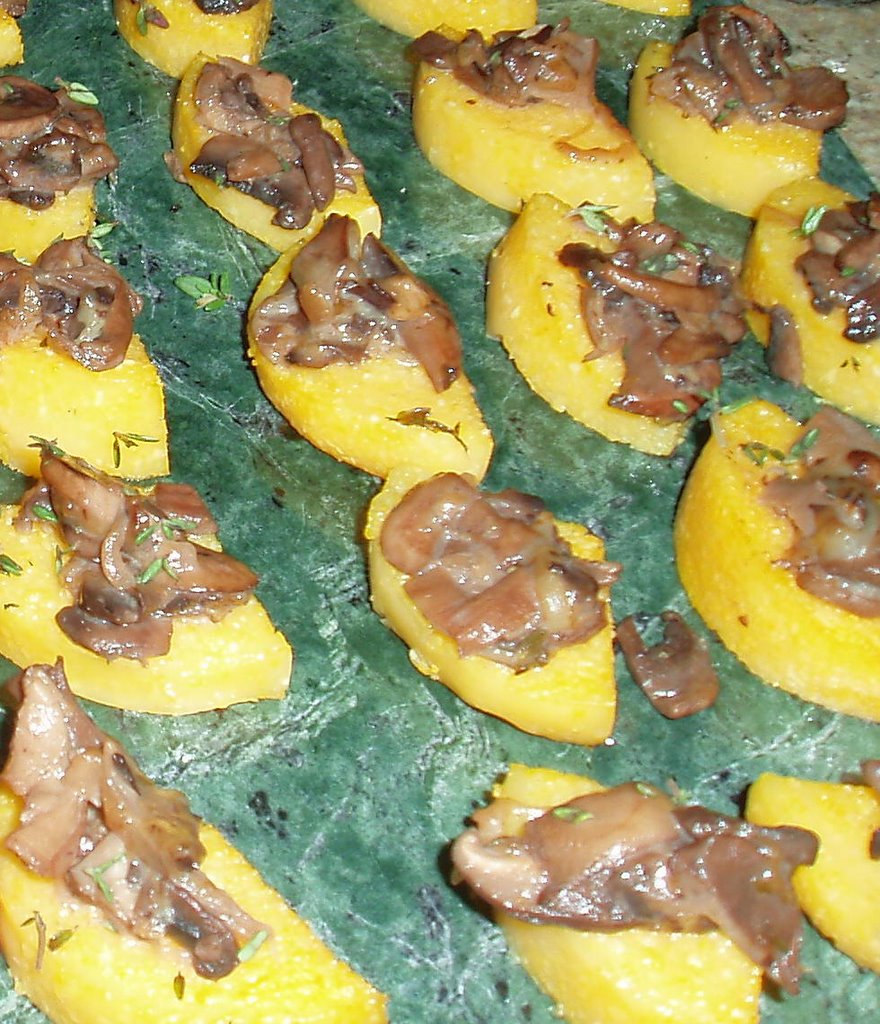
Polenta triangles with wild mushroom topping
Vietnamese spring rolls
Chocolate truffles, homemade decadent chocolate brownies, grapes
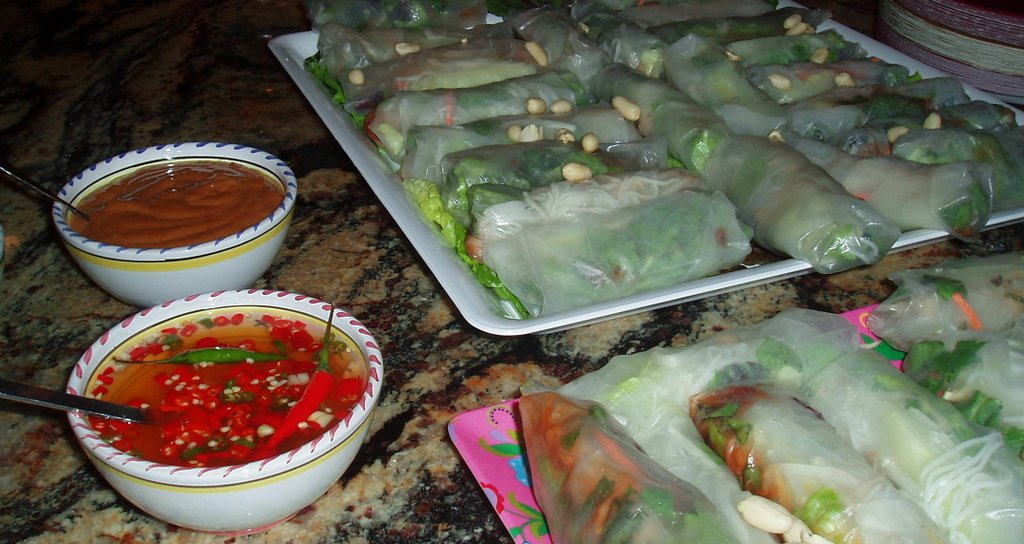
The spring rolls were based on my previously posted recipe for "not quite spring rolls." I used vegetarian “fish” sauce and filled them with either mango slices or sticks of cucumber and crushed peanuts. In addition to a hot and sweet dipping sauce, I also made a peanut-hoisin dipping sauce.
Thank goodness for volunteers. We made more than 80 each of the two types of spring rolls. With my husband pitching in and Stacy and Karen’s help, I estimate it took us close to eight hours combined to just roll the rolls.
The rolls were delicious, crunchy, sweet, sour and fun to eat all at the same time.
The brownies were luscious, rich and grown up tasting. Since I didn’t make them, I don’t have the recipe, but I am trying very hard to get it, so watch this blog!
The polenta triangles were also a big hit. The mushroom topping had a satisfying, earthy taste that would work well with some adaptations as a main dish stew. Because we were featuring the wine, not the food, that night, I kept the seasoning subdued. If you want more of a flavor punch try adding the optional red pepper flakes and/or doubling the garlic. It would have been nice if I had written down a real recipe, but I kind of made it up on the fly. Here’s how I reconstruct it. (FYI – All ingredients except the fresh thyme were purchased at Trader Joe’s.)
Polenta-Mushroom Bites(Servings vary depending on how thick you slice the polenta and how much filling you put on each one.)
For the mushrooms
2 tablespoons grapeseed or olive oil
1 clove garlic, minced
1 pound of mushrooms, mixed mild and wild (I used a simple mix of white button and brown crimini since I was cooking for 60 and trying to keep costs down), cleaned, (note: if you use Portobello mushrooms, cut off and discard the black gills underneath the caps, otherwise your mushroom mixture will come out an unappealing muddy color) stemmed and thinly sliced. Then lay the slices on their sides and slice again, almost as if you were creating thin sticks or juliennes of the mushrooms. Alternatively, you could just chop the mushrooms. Or do some combination of the two techniques.
2 ounces of dried mushrooms (porcini or other wild mushroom or mix), soaked in hot water to cover for 30 minutes or until soft. Drain mushrooms but reserve liquid. Slice as above or chop. Strain liquid through a coffee filter or cheesecloth. Discard solids.
1 teaspoon fresh thyme, minced (if fresh thyme use ½ teaspoon dried)
¼ teaspoon red pepper flakes (optional)
salt and pepper
¼ cup shredded cheese (I used a parmesan, fontina, asiago and mild provolone mixture.)
Heat oil in large sauté pan. Add garlic and sauté until golden. Add fresh mushrooms. Sauté until water is released. Add reconstituted mushrooms. Sauté until water from mushrooms is evaporated. Add in reserved, strained mushroom soaking water. Sauté a bit, add in thyme and red pepper flakes and salt and pepper to taste. Sauté until mushroom mix is softened and cooked through. If mixture gets too dry add in a bit of water or stock. Stir in cheese until melted and well combined.
(To make ahead, make as above but do not add cheese. Add cheese after reheating. You may need to add more liquid when reheating.)
Polenta Triangles
Preheat oven to 350 degrees
1-24 ounce tube prepared polenta
oil or oil spray
Spray or brush cookie trays with oil
Slice polenta into even rounds about ¾ inch thick. Cut each round into thirds, so you have three more or less equal triangles from each piece. Place on prepared trays.
Spray or brush tops of polenta with oil. Bake in a 350 degree oven until slightly golden and warmed through.
Assembly
Warm, baked polenta triangles (see above)
Warm mushroom topping (see above)
Shredded cheese or parmesan curls (optional)
Chopped, fresh herbs (either thyme or parsley)
Top each polenta triangle with a teaspoon or so the mushroom filling. Scatter a bit of the fresh herbs on top. (note, if using thyme, just use a pinch or so on each one). Place a parmesan curl or a sprinkle of shredded cheese on top and serve while warm.
The clean corn taste of the polenta with its slight crunch from being baked complements the richer, more complicated tastes of the mushrooms and makes for a great one or two bite appetizer.
Since they are best warm, we pressed two teen volunteers into service to pass the polenta-mushroom bites around. (Special thanks to Emma and Noah, aka Blog Appetit’s youngest son.) But honestly, the bites were still tasty even when they cooled and were fine put on a platter and left out for the party goers to help themselves.
Tuesday, January 31, 2006
Not Quite Spring Rolls
Somehow the winter weather has made me long for a taste of spring. What better way than with a fresh Vietnamese-style spring or salad roll, filled with healthy greens, fragrant herbs, crunchy vegetables and moist tofu, shrimp and/or fruit. Since these rolls are mostly vegetable and eaten fresh without frying they are naturally low in fat and calories.Forming the rolls is not that hard after you practice with one or two, and even if your handiwork is a bit messy, all the tastes still combine wonderfully in your mouth. Hey, you deserve a spring break, even if it is winter.
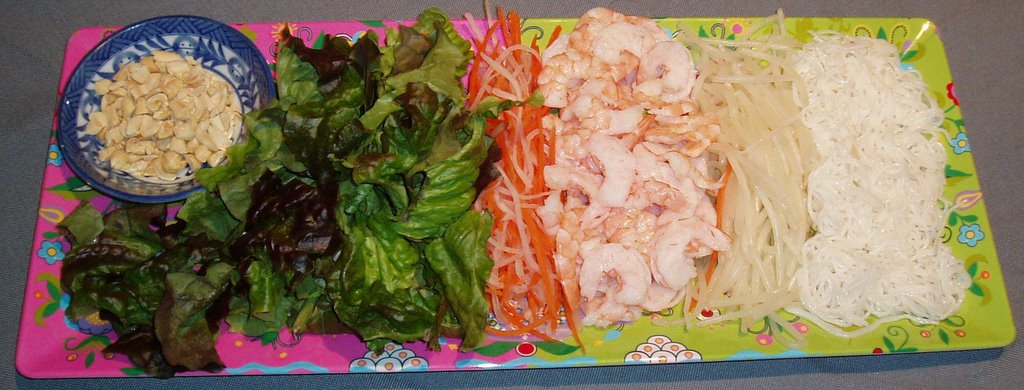
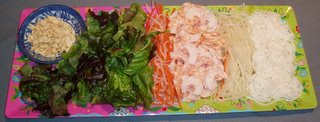
Don’t be intimidated by the list of ingredients. I’ve given you a lot of options and you aren’t supposed to make them all. Here in the San Francisco Bay area we have lots of Asian markets so everything is pretty easy to get, but most of the ingredients can be bought at a good supermarket or gourmet store. I suggest alternatives to anything that might be truly exotic or hard-to-find and list web resources at the end of the post. Most of the work for this dish is in the shopping, especially if you serve them as we do. We tend to put out piles of the ingredients and either encourage everyone to wrap his or her own or my husband, Gary, assembles them to order. It’s a great dish for entertaining. The photo above was taken at a recent dinner with friends and shows the ingredients ready to wrap and roll.
While we ate spring rolls throughout our recent trip to Vietnam, we never quite had any like this, but the ingredients did vary. The fresh ones were very refreshing in the hot, steamy weather of Hanoi. Some spring rolls we saw or ate had cooked pork, chicken or mushrooms in them. Often they are fried. (One memorable version in Hue was filled with meat, fried, sliced into small pieces on the diagonal, speared with toothpicks and stuck decoratively in a pineapple in a way that resembled a peacock’s tail. It was quite spectacular and made me truly sorry that my camera battery was dead. The fact that it appeared that the pineapple itself was reused in the display for the next customer did not dim its charm.)
Not Quite Spring Rolls
Serves 8 as an appetizer, 2 rolls a piece
Part A – the Main Filling - Choose One or More of the Following:
16 medium to large shrimp, cooked, peeled and deveined, sliced in half vertically, so you have 32 flat halves. Drain well and pat dry.
4 ounces of firm tofu, cut into matchstick-size pieces, patted dry and sautéed or stir fried in a tablespoon of oil until just golden. Splash with a teaspoon or two of soy sauce and stir until the tofu pieces are coated with the soy sauce. Remove from the pan and drain well. Mix cooked tofu pieces with 1 teaspoon very finely minced lemon or lime zest.
4 ounces fresh, ripe, peeled and seeded (but still firm) mango or papaya, cut into matchstick-size pieces and drained.
Peeled, seeded, cucumber cut into matchstick-size pieces. Place on paper towels and allow to drain. Pat dry before using.
Part B – Rice Stick Noodles and Other Shredded Things -- Offer the Rice Stick Noodles and One or More of the Following for a Total of Four Cups or More
Prepared rice stick noodles or “bun,” rinsed in water, drained well, cooled. (These are dried, very thin rice noodles that are available in Asian markets and some supermarkets. Sometimes called rice vermicelli. Be sure to buy the very thin noodles made from rice or rice flour and not mung beans or wheat flour. Careful not to get the thin “banh pho” rice stick noodles, which are flat noodles for soups and look like linguini.) To prepare, cook about 4 ounces in boiling water for about five minutes.
Rinsed, cleaned fresh mung bean or other sprouts, well drained
Cooked, cooled, spaghetti squash, separated into noodle-like strands (very untraditional but adds a nice flavor, crunch and nutrient boost)
Finely shredded green papaya. Green papaya is not unripe regular papaya. It is a separate variety of the fruit that is eaten like a vegetable. It is available in many Asian specialty markets. It adds a bit of taste and a lot of texture to the spring rolls.
Finely shredded carrots
Finely shredded daikon radish or jicama. Daikon radish is long and white and on the mild side. Jicama works fine if the radish isn’t available. Or try finely shredded turnip for a more peppery taste.
(Note: Some Asian markets sell fresh pre-shredded green papaya and a mix of pre-shredded carrots and radishes in the produce section.)
Part C- Herbs and Greens – Use One Cup of FRESH Herbs to Go with the Lettuce for a Total of Two Cups Herbs and Greens
One cup shredded red or other soft, leaf lettuce (should be bite size pieces)
Plus One Cup of a Combination of the following:
Asian or Thai basil, chopped or shredded without stems. Sometimes called anise basil. (Do not substitute Italian style basil)
Mint, chopped or shredded without stems
Cilantro, chopped or shredded with harder stems removed
Vietnamese herbs (available in some Asian stores) such as “ngo gai,” saw-leaf herb (a member of the cilantro family), “rau ram” (Vietnamese coriander), and many others. Chopped or shredded with harder stems removed
Part D – Sauce -- Pick One or Both, You’ll Need a Little More than a ¼ Cup Total
Prepared Hoisin Sauce (buy a good quality one)
Peanut - Hoisin Sauce mixed one part hoisin sauce, one part good quality smooth peanut butter. Stir. Add hot water by the teaspoonful and keep stirring until mixture is smooth and well combined. Optional, add a splash of Vietnamese or Thai Fish Sauce (see note below in dipping sauce segment) or soy sauce.
Part E – Wrappers -- Pick One or Do Some of Both
16 (plus extras for the learning curve) Vietnamese dried round rice paper wrappers for spring or salad rolls (“banh trang”). Be sure you get wrappers made from rice not wheat flour. The size of these round wrappers seems to be very consistent between brands.
16 red lettuce, butter lettuce or other soft leaf lettuce leaves, washed, drained and patted dry (plus extras for the learning curve)
Use the lettuce leaves if you can’t get the wrappers. Wrapping ingredients like this in a lettuce leaf is not uncommon in Vietnam and is usually referred to as a salad roll. Obviously, if you are making some of each, you'll need only need 16+ total for both.
Part F – Dipping Sauce & Garnish
Nuoc Cham – Spicy Dipping Sauce
1 clove garlic, peeled and very finely minced
2-3 small hot red fresh Thai (bird) or Serrano chiles. (Remove seeds if you want a less hot sauce), very finely minced. (If it’s all you can get, use fresh jalapenos)
1 tablespoon plain, unseasoned rice vinegar
Juice of one lime
2 tablespoons sugar
¼ cup water
Tablespoon of mixed finely shredded carrot and daikon, chopped
One tablespoon Vietnamese or Thai Fish Sauce (See Note.)
Combine all ingredients and mix well. Put out in small bowls for dipping.
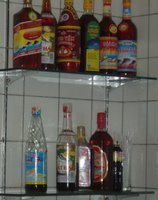
Note: In the photo at left are different kinds of Vietnamese fish sauces (“nuoc mam”) on display at the kitchen of a hotel in Hanoi. The nuoc mam that is imported to the U.S. is most often made with anchovies. The sauce adds an indefinable boost to many Vietnamese foods and sauces. Thai fish sauce (‘nam pla”) is an acceptable substitute. If neither is available or if you are making strictly vegetarian food, substitute a combination of unseasoned white rice vinegar and soy sauce, maybe even mushroom soy sauce. I have seen Thai fish sauce in many supermarkets and both are available in Asian markets.
For a mouth watering discussion on why fish sauce seems funky but can be addictive, please read Orangette's musings.
Garnish -- ¼ cup roasted peanuts (not salted), chopped.
Assembly
At last, after all that shopping and chopping and shredding – here’s the pay off, you get to eat these rolls and customize them to your specifications.
Set out all of your choices from Parts A through D plus the peanuts. Put dipping sauce into conveniently placed bowls.
Prep rice paper wrappers. Have a flat, open container for some hot water, big enough to submerge a wrapper in without folding or bending. Submerge wrapper long enough for it to soften. Timing will depend on brand, temperature of the water and atmospheric conditions. Wrapper will emerge very soft and pliable. Place wrapper on a lint-free kitchen or tea cotton towel. It is ready to fill and roll.
If your softening of the wrappers gets ahead of the rolling, cover softened wrappers with a damp cotton towel. Don’t let wrappers sit too long.
To fill, place wrapper round in front of you. All the action is going to happen on the bottom third of the round. Start by dabbing a half teaspoon to teaspoon of either the hoisin or peanut-hoisin sauce in the middle of that bottom third section. Select your greens, herbs, shredded vegetables, shrimp, etc and place in that bottom third, leaving about an inch margin on both sides and the bottom. Top off with a sprinkling of the chopped peanuts.
Fold up 1” margin from the bottom over filling and then fold 1” margin on the sides of wrapper towards the middle over filling. Roll bottom third over towards middle and then roll again, using your fingers to help compress the roll. It is like rolling a burrito. (For another take on a Spring Roll Recipe and for step by step photos of how to wrap, click here from this article from Digs Magazine.)
If you are using lettuce leaves, fill and roll them in a similar manner.
Don’t worry if your first rolls are loose or messy. They will taste just as good.
Dip the finished roll into the dipping sauce and eat.
Leftovers? -- Cut the rice noodles into 2 inch lengths and combine ingredients from Parts A, B and C and chopped roasted peanuts into a salad, adding more lettuce if needed. Thin dipping sauce out with a bit more vinegar and some grapeseed or other vegetable oil if desired and toss with the salad.
------------------------------
Some resources:
Mai Pham's growing empire of things Vietnamese is a great informational resource.
There are many resources for buying Vietnamese ingredients on the web. For research purposes I checked availability from Ethnic Grocer, which also provided the spring roll wrapper photo.
While it is more of a supermarket than a charming specialty store and many of their Vietnamese selections are limited, the Ranch 99 chain of markets has all the Asian ingredients needed for this recipe, although it does not offer mail order. Ranch 99 has locations on the West Coast and Arizona.
Thai basil, bird chiles and other fresh produce are available from Import Food by mail order.
This write up is part of Sweetnicks Tuesday round up of antioxidant rich food recipes (ARF). Please check out her complete list of participants. Sweetnicks also hosts the popular Weekend Dog Blogging Photo event. This should be her year since this is the Year of the Dog.
Yep, we are in the middle of celebrating the Lunar New Year and these spring rolls are also my way of honoring the event. For more information on the traditions and meanings of the Lunar New Year, check out The Hungry Rose.
6/8/08 -- update -- this remains one of Blog Appetit's most popular posts. I recently came across this version with shrimp and steak and with step by step photos. Check it out.
Vietnamese Food
Thursday, December 01, 2005
Vietnam -- Soup with Lemon Grass
This vegetable stall is in Hanoi's December 19th market. The food is all fresh and beautifully arranged. The market is also housed indoors and a bit less rustic than the "Wet Market" in old town and much smaller and more manageable than the Central Market (which has many offerings other than food). These incredible vegetables show up in much of the food in Vietnam. Even the herbs that you sprinkle on your soup are some how more full tasting and delicious than the herbs we are used to, even here in California.
While I took lots of market and vegetable photos during my visit to Vietnam last summer, I kept forgetting to take a picture of lemon grass to illustrate my "faux" pho recipe. So here's just a food photo I like and a recipe I hope you'll enjoy.
Asian Noodle SoupAbout Eight Servings
This soup came about after my husband came back from his first trip to Vietnam. He asked me to cook “something” with lemon grass, a traditional Vietnamese flavor. I began to experiment with the citrusy, woody stalks, looking for a way to enjoy its fresh taste in a clean, vibrant, low-calorie way. A trip to the local produce store inspired this soup, which I nicknamed “faux pho,” after the Vietnamese noodle soup. Most pho soups are beef based, but my favorite was a lighter seafood and vegetable version. (If you can’t find lemon grass, add the extra lime juice, the soup is still wonderful.) Don’t forget to add the toppings to the individual bowls, they really make the dish special.
Soup Stock
· 4 cups low-sodium or homemade chicken stock or light vegetable broth
· 4 - 6 cups water (depending on how thin or thick you want your soup)
· Fresh ginger root, the size of a walnut, peeled and cut into thin slices
· 2 stalks of fresh lemon grass (do not substitute dried), trimmed with root end cut off, outer leaves peeled off and darker top stems discarded, leaving two approximately 8 - to - 10 inch stalks. Slice each stalk into half lengthwise creating four half stalks.
“Hard” Vegetables
· 1/4 cup chopped shallot or red onion
· 1 large red bell pepper, cut into ½ inch to ¾ inch dice
· 3 cups of chopped Asian (such as bok choy, baby bok choy, Napa cabbage) or green cabbage. (I used baby bok choy, saving the green leafy part for use later in the recipe and just using the white stalks for this part.)
· 8 to 12 fresh or reconstituted dried shitake mushrooms or 8-12 medium large white button mushrooms stemmed and cut into quarters. (I think the flavor and texture of the fresh shitake are really special in this soup. To use dried, soak in hot water for 30 minutes until soft.)
· 2 large carrots, cut into thin slices
Greens
· 3 cups of Asian greens or spinach leaves, chopped. (I used the tops of the baby bok choy here as well as pea sprouts, which look like miniature spinach leaves with a long thin stem. Produce and specialty markets have a variety of Asian greens such as pea sprouts and mizuna.)
Seasonings
· 4 tablespoons of Vietnamese or Thai fish sauce (sometimes labeled nam pla or nuoc mam), available in large supermarkets and specialty stores. If you don’t have it, see soy sauce.
· 2 tablespoons of soy sauce. If you are not using fish sauce, increase to 4 tablespoons
· Juice of ½ of a fresh lime. If you are not using lemon grass, increase to juice of a whole lime
· Fresh small hot red pepper (such as Thai, serrano or jalapeno), cut into thin rings, optional
The Noodles
1/2 pound of dried rice noodles
Look in the Asian or regular market for dried rice noodles about the width of fettuccine noodles (about ¼” wide). In Vietnamese they are called banh pho, but often they are packaged for Thai dishes as pad Thai noodles. If you can’t find rice noodles, fresh fettuccine is a good alternative. Cook before using.
Toppings
· Bean sprouts
· Chopped mixed herbs – basil, cilantro and mint (mandatory)
· Lime wedges
· Hot sauce, chili paste or other red pepper based sauce
· Hoisin sauce (optional – but I really enjoy it)
· Chopped green onions
Preparation
Combine soup stock ingredients and simmer for a half hour or until the mixture has picked up the lemon grass and ginger taste.
Add hard vegetables and simmer until almost soft. Add the greens and simmer two to five minutes until they begin to soften. Add seasonings, stir well and cook until greens are cooked through. Discard lemon grass stalks and ginger slices before serving.
Bring a large pot of water to a boil and put in the rice noodles. Cook for about five minutes and drain. Rinse in cold water.
To serve, add a portion of the noodles to the bowl before adding the hot soup, which will warm the noodles through. Ladle soup into bowl, top with a handful of bean sprouts and about ¼ cup of chopped mixed herbs. Pass the other toppings so every one can season to taste. A small spoonful of the hot chili paste or hoisin sauce will flavor a big bowl of soup, so add condiments a bit at a time.
Note: The chopped herbs are an important component to the taste of this soup and the bean sprouts add a very satisfying crunch. I urge you not to skip them.
Make it a Meal – Make it more substantial by trying one or both of these options.
1. Add small cubes of firm tofu after the hard veggies have been cooking a few minutes. Try about 4 to 6 ounces if using the shrimp below, or use 8 ounces if just using the tofu.
2. Add in some peeled, deveined shrimp. Add after the greens have simmered a minute or so. Simmer soup just until shrimp are pink and barely cooked through. The shrimp will continue cooking in the hot broth and will toughen if overcooked. Use about a half pound if using the tofu. If not, try a pound or so.
Friday, October 21, 2005
Vietnam -- Pyramid Power

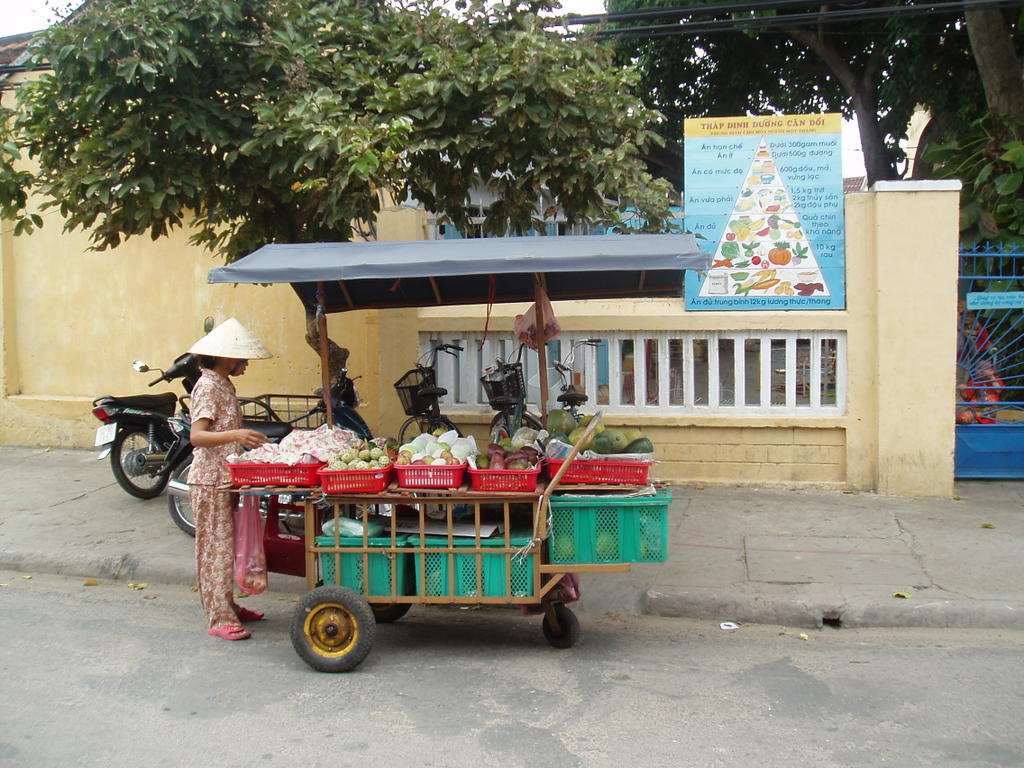
In Hoi An, Vietnam, students at this primary school get a colorful visual of what it takes to eat healthy.
This food pyramid poster is at the main gate. In front of it is a vendor selling the students and other passersby some of the fruits illustrated on the chart.
Hoi An is at the mouth of a river and on the South China Sea.
Centuries ago it was an important trading port and Japanese, Dutch, Portuguese and Chinese influences can still be seen in town and are reflected in the food. "White roses," a kind of dim sum that seems Chinese in origin, are a local favorite. Also, a type of cracker bread was served at most meals at local restaurants instead of or in addition to rice.
We had some of our favorite meals in all of Vietnam in Hoi An at the Mermaid and Cafe des Amis restaurants. Watch this blog for more about the food and cultural heritage of Hoi An and Vietnam.
Tuesday, October 18, 2005
Vietnam -- On The Street Where You Eat

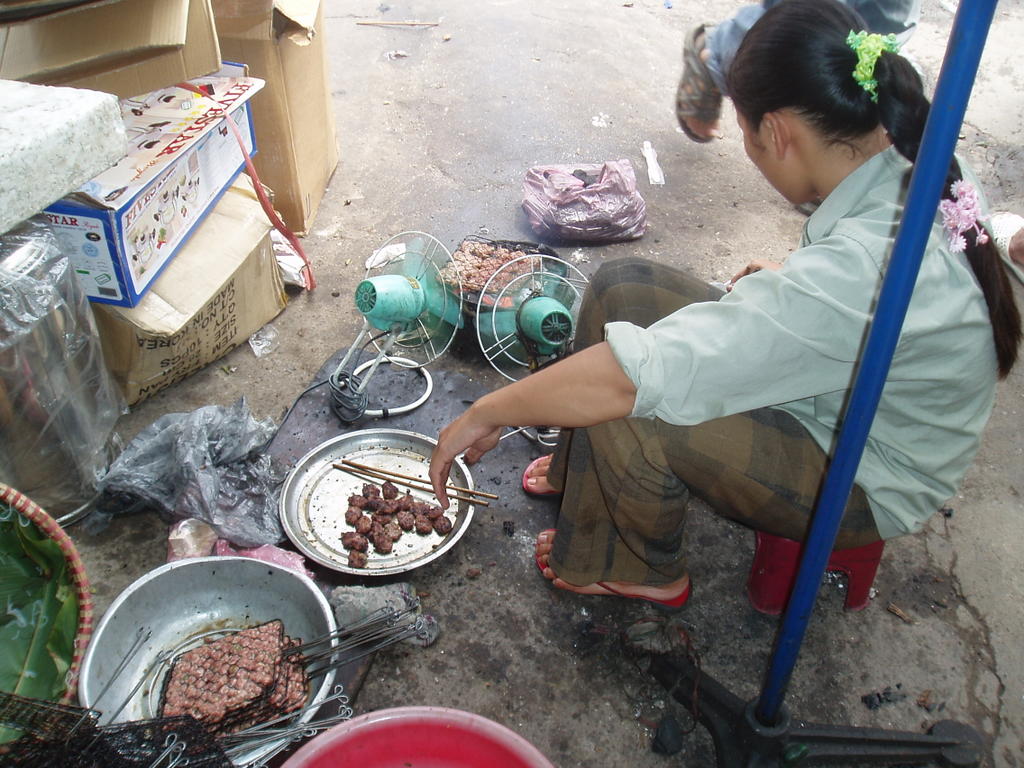
A street corner chef in Hanoi, Vietnam, this past August barbecues the meat for bun cha over a small charcoal brazier. This pork, rice noodle and broth one dish meal was one of the best meals of our lives and cost roughly $1.10 for the two of us.
We sat at a low table surrounding by locals who seemed tickled to see the big clumsy Americans try to fit on the small stools. But our enjoyment of the food transcended our differences and we all were nodding and beaming and smiling at each other in no time.
I had the "fancy" version of this dish at my cooking class at a hotel in Hanoi. It was good, but our street corner repast was even better.
Watch for more on food in Vietnam.
Friday, October 14, 2005
Hats off to Vietnam

Tonight we thanked some friends for lending my husband a sun hat for our trip to Vietnam. We invited them to dinner and when they were too full to move sprung the photos on them! We had culled down our digital photos to only 132 images (which was still way too many) and played some of the traditional music cds we bought for atmospheric music.
We also put on a feast -- vegetarian salad rolls, green papaya and chicken salad, lemongrass beef with rice noodles, water spinach with garlic and taro ice cream.
When I have more time to figure this blog thing out, I'll post some Vietnamese photos. I'll post some recipes from the dinner, too.