Showing posts with label Turkey - the Country. Show all posts

Tuesday, December 31, 2013

My Lemon Mint Tea Story - From Hammam to Tea Cup

This the first in an occasional series highlighting some of the many teas I regularly drink  (or at least sample).  Since I just inventoried my decaf and herbal teas I know I have 27 boxes or tins of these types alone so this could be a very long running feature.  In addition, I have another few dozen individual leftover and sample tea bags, too.  I haven't begun to inventory the black, green and white teas  I've accumulated.  Plus I have a lot of tea strainers, pots and other equippage to blog about. Oh, and the Fancy Food Show is next month and I always find new teas to try there.

I first learned about the wonderfully refreshing powers of lemon mint tea while I was laying half naked on a small towel on a large marble platform surrounded by billowing, hot steam in a Turkish hammam looking up at the intricately carved domed ceiling and feeling languid in the heat. Christina, one of my traveling companions, was telling me how she was able to find this tea, a favorite of hers she has bought all over the Middle East in Istanbul and encouraged me to seek it out.

"I can't believe Lipton makes it and you can't buy it in the States," she said.

I'm a big fan of both flavors and was intrigued enough to buy a box of Nane Limon Tea (once I had my fill of steam, cold water pool plunges, massages and brisk body scrubs at the hamman) at a Turkish grocery store to bring back with me.

Back in California, I brewed a cup and took a small sip. It was as marvelous as Christina had promised. It is more of an herbal infusion than a tea since the ingredients are pretty much just fruit flavor and herbs such as lemon grass and mint. I found it warming in the winter, cooling in summer.  It was a good pick me up yet it also was a good tea to relax with. It was great iced. It was great hot. Because it was herbal and had no caffeine I could drink it any time.  Only one problem -- I only had 20 tea bags of the stuff.

I hoarded my supply and stopped sharing it with friends and relatives. I searched all the local ethnic and gourmet markets -- no Lipton lemon mint tea, or even any substitutes.

I checked the U.S. Lipton website. Not there.  (But you can see it on the Turkish site.) I thought about mixing a lemon tea with a mint tea and making my own but before I could begin to experiment, I found a replacement brand in a local market specializing in Jewish and Israeli foods.

That's where I found my current lemon mint tea crush -- Wissotzky Nana-Lemon Tea. It's not exactly the same, but very close and wonderful in all the same ways as the Lipton version.  Wissotsky is made in Israel and is available through mail order as well as in some stores here in the U.S.  It's only $2.99 for 20 bags -- a whole lot cheaper than another trip to Istanbul, but of course, the hammam experience is not included.
----------------------------------
The Lipton's box lists ingredients as: lemon grass, mint, lemon peel, lemon flavor, citric acid and chicory root. The Wissotzky tea ingredients as per the box are: Mediterranean spearmint leaves, rosehip, orange and lemon peels, citric acid, spearmint and lemon flavors. I haven't tasted these side by side so I can't say which I like better.

Thursday, July 04, 2013

Obligatory July 4 Food Blog Post (With Menu Suggestions, Red White and Blue Food and a Spicy Burger Recipe)

Red, white and blue sorbet for Independence Day
It's July 4 and I believe food bloggers are contractually obligated to come up with a post that celebrates one or more of the following:

  • Red, white and blue themed food, often but not limited to either gooey desserts and or strawberries and blueberries
  • Food for the grill
  • American classics - either retro or revisionist

Better yet, if the blogger can somehow combine all three in one post they have hit the Facebook share trifecta.

My take on the foods of America to celebrate Independence Day is a bit different -- I'd prefer to focus on the foods brought to our shores and adopted (adapted? distorted?) by the teeming masses already here looking for the next big flavor hit.  America's taste buds are not so much analogous to a melting pot as they are a fusion reactor.

Based on what I've written about before on Blog Appetit, here's some ideas for going forth and partying on the Fourth of July celebrating the glorious diversity of foods and ingredients immigrants (and savvy marketers) have made popular here.  Think of it as a United Nations for your mouth.

Appetizers:

Any Night Cerviche (Mexico and Central America)
Tomato-Mango Bruschetta (India, Italy and Berkeley - which many Californians consider a separate state of mind)
Tortilla de Espana (Spain)
Not Quite Spring Rolls (Vietnam)

Main Dishes:

Egyptian Grilled Lamb
Grilled Chicken Kabobs with Pomegranate Molasses BBQ sauce (Middle East) -- also the link has a recipe for a berry sorbet for dessert you can dress up in red, white and blue.
Cincinnati Chili (Greek-American) -- works great as a hot dog topping, too.  For more American regional hot dog ideas, click here.
Grilled Vegetable Kabobs with Miso Glaze (Japan)
Turkish Inspired Hamburgers (see recipe below)

Other:

Assorted North African vegetable salads
Cold Beet Borscht (Russia)  Nice and red, serve with some blue corn chips and sour cream for the obligatory red, white and blue dish.
Cold Asian Noodles with Veggies and Peanut-Tofu Sauce (China)
Pomegranate Coconut Pudding (Near East/Mid East)
Lychee Sorbet (China)

See the link for the bruschetta above for an Indian-inspired rice pudding and the link for the chicken kabobs for a the very berry sorbet recipe (French?).

And of course, cruise the different categories listed in the labels section in the right column for even more recipes that help you cook local and eat global.

Oh, and happy birthday to my beloved father-in-law.  Vic's enthusiasm for my cooking is just one of his many, many wonderful traits.  Happy 89, Dad.

Keep reading for the Turkish burger recipe.

Tuesday, October 09, 2012

Turkish-Inspired Stuffed Eggplant Recipe a Delight


This is a version of an eggplant dish I first ate during a visit to Istanbul.* Like most stuffed vegetable dishes, this one does have a lot of steps, but the entire dish can be made ahead and served reheated or at room temperature. The rich lamb is tempered by the onions, garlic, tomatoes and fresh herbs and its eggplant casing becomes silky soft and delectable as it bakes. Serve with rice, couscous or a small pasta such as orzo on the side.
I should point out that when this recipe first appeared in the j.weekly, a reader from a Turkish background took me to task for saying you could serve this dish at room temperature.  Lamb is never served at room temperature in Turkey I was informed.  That is true so if you want to eat it at room temperature, please do, but understand most folks would not do so in Turkey. I do not recommend eating it cold or chilled, however.
Friends have said they don't eat lamb and asked for substitutions.  Try it with dark meat ground turkey or beef, or make it vegetarian like the dish that inspired this recipe (called the Imman Fainted).  You may want to use more tomatoes to make up for the absence of the lamb.  Or you can chop, cube and fry the eggplant that was removed when you hollowed the vegetables out and add when you would mix the lamb in with the tomatoes and onions.
Afiyet olsun! (Or bon appetit in Turkish.  If you speak Turkish and that's wrong, please let me know!)
Turkish-Style Stuffed Eggplant
Serves 6-8
1 tsp. salt
4 cups very thinly sliced onions (no thicker than 1/8”)
1 Tbs. canola oil
1 Tbs. minced garlic
1 lb. ground lamb
1 lb. medium tomatoes, peeled and seeded (see note)
2 Tbs. tomato paste
1 tsp. paprika
1/2 tsp. ground black pepper
1/8 tsp. sugar
1/3 cup finely chopped fresh dill
1/3 cup finely chopped fresh mint
2/3 cup finely chopped fresh, flat leaf parsley
4 Tbs. fresh lemon juice
2 medium eggplants (1 lb. each)
1/4 cup olive oil
1 cup water
Chopped dill, mint and or parsley for garnish, optional

Preheat oven to 425 degrees. In a large bowl, sprinkle salt over onion slices, toss well. Heat 1 Tbs. canola oil over medium high heat in large sauté pan. Add garlic and sauté until golden. Add lamb and sauté, stirring and breaking up any clumps, until just browned, about 2-3 minutes. Drain and discard any excess liquid and add lamb to onions. Cut tomatoes into 1/2” chunks and add with tomato paste, paprika, pepper, sugar, dill, mint, parsley and lemon juice, mix well.

Prepare eggplants. Trim off leaves, but leave stems. Slice in half lengthwise. Use a paring knife or vegetable peeler to remove 3 lengthwise strips (each about 3/4”-1” wide) of eggplant skin from each half, starting at the stem end and leaving the skin intact between strips, creating a striped pattern. If needed, slice a bit off the rounded bottom to stabilize. Use a large spoon to hollow out the eggplants, being careful not to pierce to skin. Leave 1/2" of flesh all around. Reserve scooped out eggplant pieces for another use or discard.

Pack each half with the filling and mound more on top, covering the surface of the eggplant to the edge. Place eggplants skin side down and side by side in a 14” x 9” baking pan. Drizzle olive oil over tops. Pour water down the sides of the pan. Loosely cover with aluminum foil. Bake for about 60 to 75 minutes (timing can vary greatly, so it may take more or less time), until onions are tender and eggplants are very soft. Check every 30 minutes, basting with cooking liquid and adding more water to the pan if necessary. When done, baste once more and remove from the pan, discarding cooking liquid. Sprinkle with chopped herbs if desired. Serve hot, warm or at room temperature.

Note: To peel tomatoes, cut a cross into the stem end about 1/8” deep. Place in pot of boiling water to cover. Let simmer 2-3 minutes until skin is loosened. Remove, let cool and rub or peel off skin. To seed, slice in half and gently squeeze out seeds.
----------------------------------
*I am long overdue for writing up more about my trip to Istanbul last year, including the cooking class were I first made the vegetarian version of this dish.  I'll update this post with a link to those experiences when I finally do the write ups.

Monday, May 09, 2011

Turkish Flavors Meld in Lamb Stew

Not long after I returned from Turkey I made this stew.  It's a tasty amalgamation of several lamb and vegetable stews I had during my trip.  Many Turkish meat dishes are flavored with  fresh dill, so I incorporated that into this dish.  I served this with bulgur, a frequent Turkish side dish, but rice would also work well. 


Lamb Stew with Tomatoes, Peppers and Dill
Serves 4

1 lb. eggplant
1/2 tsp. salt plus additional if needed
2 Tbs. vegetable oil
1 lb. boneless lamb stew (1” cubes)
2 cups slivered onions
2 garlic cloves, minced
2 cups red bell pepper pieces, sliced into 1/2” strips
1/2 cup sliced carrots, cut into 1/4” rounds
2 cups cubed potatoes cut into 1/2” chunks
1 lb. tomatoes, chopped
1/2 tsp. ground black pepper
1/2 tsp. hot red pepper (chili) flakes
About 2 cups chicken stock
1 Tbs. plus 1 Tbs. chopped fresh dill

Peel eggplant if desired. Cut into 1” cubes, toss with 1/2 tsp. of salt. Place in colander. Let sit for half hour. Rinse and drain well. Dry.

Heat oil in deep sauté pan or large pot over medium high heat. Brown lamb chunks. Remove from pan and set aside. Add onions and sauté until golden. Add garlic and sauté for one minute. Add eggplant, red pepper strips and carrots. Sauté for 2 minutes. Add potatoes, tomatoes, black pepper and red pepper flakes. Mix well. Add lamb pieces with any juices. Add stock until ingredients are submerged about 3/4 of the way. Bring to a simmer, stirring occasionally. Cover, lower heat and simmer for about 1 hour (until lamb chunks are very tender, time may vary), stirring occasionally and adding additional stock if necessary. Remove cover, stir in 1 Tbs. of dill. Cook for about 25 minutes until stew is thickened and meat is extremely tender. Taste and mix in salt if needed. Sprinkle with remaining dill.

Friday, April 15, 2011

"Shredded" Pastry with Nuts -- Make Room on Your Passover Table for a Turkish-Style Delight

This recipe has so many back stories I don't know where to begin.  But I do know how it should end -- making this dessert filled with chopped walnuts and raisins and soaked in a lightly sweet lemon syrup for a Seder or other event this Passover. 


First back story -- when I was in Turkey I saw lots of shredded phyllo (filo) dough pastries and sampled quite a few, all with a sweet syrup and most filled with chopped nuts and or dried fruits.  I also had my share of the more familiar baklava.

Second back story -- when I returned from Turkey, I needed to create some Passover recipes for my weekly j. column and since I was still enthralled by the dishes I ate in Istanbul, Cappodocia, Esphesus and elsewhere, I decided to recreate some of the food I ate there for Passover. I thought I would try to make a matzo baklava.  When I went shopping I saw the very fine, thin Pesach egg noodles and I had one of those recipe creation a-ha moments.  What if I used the egg noodles instead of the matzo and made the dish more like the shredded phyllo pastries I saw and ate?  I tinkered a bit in the kitchen crossing some ideas for individual shredded phyllo pastries with some I saw that used the ingredient in more of a pie and came up with this recipe.  My testers could not believe it was a Passover dessert.  It was a hit.

Third back story -- there was no room in the column for this fabulous recipe and it had to be cut.  So for the first time anywhere, here is my Passover "Shredded" Pastry recipe.  Enjoy.

Passover “Shredded” Pastry
Makes 16 pieces

Cutting the dessert into 16 pieces before cooking makes it much easier to serve. This sugar syrup is not as sweet as the traditional Turkish style one would be.  (FYI - Passover fine egg noodles are made with matzo meal and are a few inches long and about 1/8th of an inch wide.)

Syrup
1 ½ cups cold water
½ cup sugar
Juice of one lemon

Pastry
1/3 cup of raisins
4 oz. parve Passover margarine or butter plus extra for greasing pan
3 ½ oz. (about 1 cup) shelled walnut halves
½ tsp. ground cinnamon
¼ cup sugar
1-12oz, bag of Passover fine (very thin) egg noodles, uncooked
1 cup hot water
16 walnut halves for garnish

Make sugr syrup by combining water, sugar and lemon juice in a heavy pot over high heat. Stir until mixture boils, then stir occasionally, boiling for about 15-20 minutes until mixture is reduced by half. Let cool then chill.

Soak raisins in boiling water to cover until softened, about 20 minutes. Drain and discard water.

Grease 8”x8” pan. Preheat oven to 350 degrees.

Combine drained raisins, walnuts, cinnamon and sugar in food processor or blender. Chop until coarsely ground. Set aside.

Melt margarine or butter. While still warm toss with the fine (thin-style) egg noodles and 1 cup hot water.

Press half of the noodle mixture into an even layer in the prepared pan. Top with layer of raisin and walnut mixture. Pat another layer of the noodle mixture evenly on top of the filling. Distribute any extra margarine mixture evenly on top of the final layer of noodles. Cut into 16 squares.

Bake for 30-35 minutes until golden and toasty. Immediately pour cold sugar syrup evenly over top.

Rest to let pastry absorb the syrup. Top each piece with walnut half. Serve warm or at room temperature.

UPDATE: 3/12 -- Several brands of Passover noodles are now gluten free.  Look for those and this recipe is appropriate for those on a gluten-free diet.

IMPT UPDATE 4.12 -- The gluten-free noodles do not seem to work as well.  Suggest using boiling (not hot water) and let soak awhile before using.  I couldn't find regular only gluten-free Passover noodles, so I'll have to update and revise recipe completely.  FYI - you need 12 ounces of noodles, but the new-style only come in 9 oz. packs.

Saturday, April 09, 2011

A Taste of Turkey -- Easy Baklava Recipe

I'm still working out the kinks on my versions of the different foods and dishes I tasted in Istanbul, Cappadocia, Esphesus and elsewhere in Turkey.

In the meantime, here is the baklava recipe I usually use.  It is adapted from Paula Shoyer's excellent The Kosher Baker: Over 160 Diary-Free Recipes from Traditional to Trendy. (Brandeis University Press) Her version is vegan, has more filling and is not as sweet as many others I’ve tried. Turkish versions would omit the orange blossom water, but for other cultures it is traditional and it gives the pastry a floral essence.

I first wrote up this recipe for my friend Anna Mindess' wonderful blog, East Bay Ethnic Eats, for her post on handmade filo (phyllo) dough.

Layered Baklava with Orange Blossom Syrup
Serves 20

The mix of nuts gives the baklava a very complex taste. This recipe is adapted from Shoyer’s book. This recipe is written for defrosted, commercial filo dough. It is even more spectacular made with fresh. If you’d like, brush canola oil on the filo dough layers rather than spraying them with the spray oil as Shoyer does.

1 2/3 cups shelled, unsalted pistachios
1 cup slivered almonds
1 cup walnut pieces
2 ¼ cups of sugar, divided
Canola oil spray
1 package frozen filo dough, thawed according to package directions
Juice of 1 lemon
1 cup water
2 tsp. orange blossom water

Preheat the oven to 350 degrees. Put pistachios, almonds, walnuts and ¼ cup of sugar in food processor with metal blade. Process until ground into tiny pieces but not pulverized.

Grease a 9”x13” pan with spray oil. Cut sheets of filo to size if necessary. Lay 1 sheet in pan, spray with oil. Repeat 4 times until you have a stack of 5 sheets. Scatter ¾ cup of the nuts mixture evenly on top. Repeat until you have 5 filo layers of 5 sheets each and 4 nut layers. Finish with the filo on top. Spray the top sheet heavily with oil.

With a sharp knife, make diagonal cut through all the layers across the pan, about 1 ½” apart. Then make diagonal cuts in the other direction. Place on middle rack in the oven and bake for 30-40 minutes or until lightly browned.  As it bakes, if it looks like the top sheet is drying out, spray again with oil.

While the baklava is baking, make the syrup. Place remaining sugar, lemon juice and water in a small pan and bring to a boil. Reduce heat to medium and cook uncovered for 5 minutes. Turn heat to low and simmer for 7 minutes. Take pan off heat, add orange blossom water and stir.

When the baklava is baked, remove from the oven and immediately pour the syrup over it. Let cool in the pan.

------------
This recipe and information also appeared in the j. weekly in a review of the Shoyer book.  Additional recipes are included.

Sunday, March 27, 2011

I'm Back

Back from Istanbul and full of good food, good stories and great pix.
Watch this blog for more!

Saturday, October 07, 2006

All About My Jewish Cookbooks and a Turkish Greens, Potatoes and Mushroom Stew


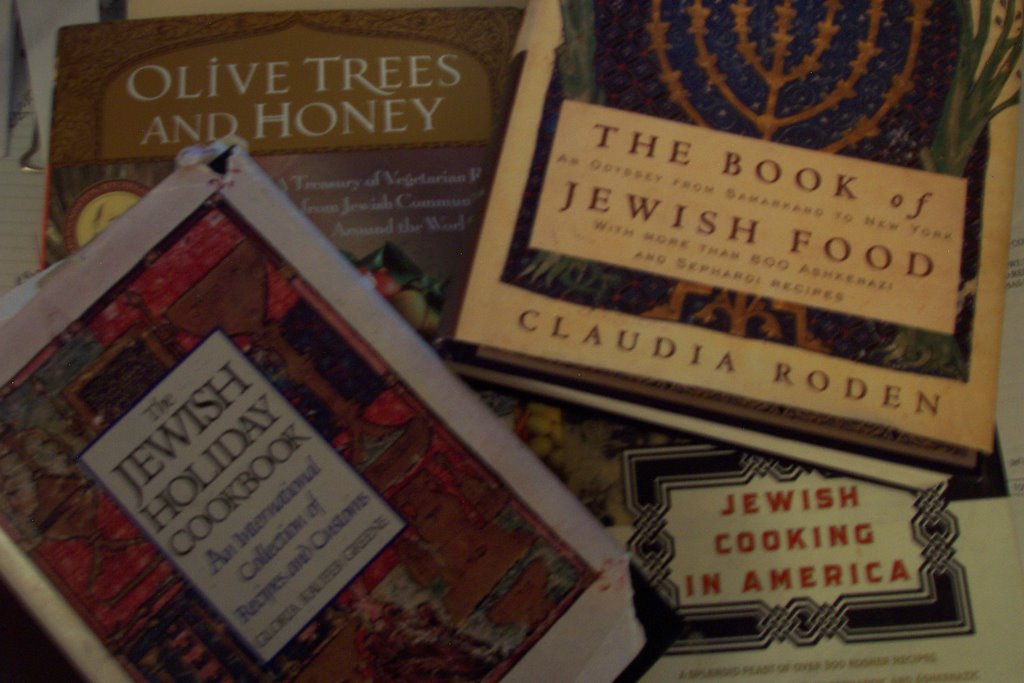
The Well Fed Network's Paper Palate site has published my roundup of my favorite Jewish cookbooks. (Please see update note below)

I really put those books through their paces this current Jewish holiday season. My menu ended up featuring the foods of the Turkish Sephardic Jewish community. A large reason for that was in remembrance of a friend who was of Turkish Sephardic heritage who was a wonderful cook.

From Olive Trees and Honey I read up on some of the Turkish holiday food traditions. I also made some wonderful pumpkin pastries called borekas from that book. I took a number of ideas from a variety of cookbooks and added my own touches to create a Sephardic chicken soup with vegetables and matzoh-fafalel dumplings. From the Book of Jewish Food I adapted a recipe and created a chicken and black-eyed pea dish for my main course. I also served a vegetarian main dish of greens, potatoes and portobello mushrooms which was inspired from a traditional Turkish recipe. My version was adapted from the book Vegetarian Turkish Cooking by Carol Robertson. My recipe is very different from hers, but she deserves credit for sparking my imagination.

As part of a mezze or appetizer plater I served small hot-sweet pickled cherry peppers stuffed with hummus (chickpea dip). Noah made apple pie for dessert. Now, apple pies aren't traditional Turkish Sephardic food, but apples are a European tradition for the Jewish New Year and Noah does like making apple pies, so that's how that came about.

Here's my greens stew recipe. It is very flavorful and flexible. You can use other types of greens and it can be a main dish or side dish.

Turkish Greens with Potatoes and Portobello Mushrooms
Serves four as a main course, more as a side dish

Olive oil or olive oil spray
2 large potatoes, peeling optional, cut into 1" chunks (I used yellow finn, but regular baking potatoes work well)
1/4 to 1 teaspoon red pepper flakes (depending on how spicy you like your food)
salt and pepper
3 tablespoons butter or olive oil
3 onions, chopped
2 cloves garlic, chopped
2 pounds of portobello mushrooms, wiped cleaned, stems discarded, black gills cut away (see note) and cut into 1" chunks
2 pounds of fresh mixed greens washed and cut into large, bite size pieces (I used a mixture of chard, collard and turnip, but you could use beet, spinach, mustard or kale as well)
1 teaspoon sugar
1 cup of vegetable stock or water
2 medium tomatoes, chopped
1 tablespoon olive oil
1 teaspoon vinegar

First roast the potatoes. Preheat an oven to 450 degrees. Grease a baking pan with olive oil or oil spray. Add potatoes. Brush the potatoes with a bit more oil or use spray. Sprinkle with red pepper and salt and pepper to taste. Put in oven and roast until cooked through and browned, turning potatoes occassionally. This should take approximately 45 minutes or so.

While the potatoes are roasting make the stew. Melt the butter (or heat the oil) in a large saucepot with a lid. Add the onions and saute for a minute or two until beginning to soften and then add the garlic. Saute to until the garlic is just beginning to brown. Add the mushroom chunks and continue to saute for a few minutes. Add the greens. Mix well with the mushrooms and saute a minute or two. Add the sugar and the vegetable stock or water. Add salt and pepper to taste. Mix well and bring to a boil. Lower heat to a simmer and put lid on pot. Cook covered for 20 minutes or until the greens have cooked through. Taste and correct seasoning. (Add more sugar if the greens are too bitter, more salt and pepper if they are too bland.)

Prepare the tomatoes. Toss the tomato chunks with oil, vinegar and salt and pepper to taste. Set aside.

When the greens are cooked, assemble the dish. Put the greens and mushroom mixture in a large serving bowl. Add in roasted potatoes and toss until combined. Top with a wide ribbon of the tomato salad mixture as a garnish.

Note: Portobello mushrooms have dark brown-black gills under the cap. These gills darken any stewed mixture they are in. To avoid this, simply slice the gills off the underside the mushroom caps after you remove the stems. This is an optional step, but I do it whenever I want to avoid the coloration issue.

Update: All the Well Fed Network/Paper Palate links are now defunct, however, you can view the Jewish cookbook post via the Way Back Machine. Keep reading for the text from that post: