My friend Anna Mindess has a wonderful new blog all about ethnic food adventures east of San Francisco Bay. East Bay Ethnic Eats is a tasty read no matter where you live. Anna is a wonderful writer but doesn't "do" recipes, so I offered to supply one for her post on handmade filo dough (Oakland's Oasis Market).
You can read about how this wonderful dough is made here and see my baklava recipe there.
Monday, October 25, 2010


Thursday, October 21, 2010
A New Take on an Old Testament Menu: Quick Steak Kabobs, Barley Cakes and Yogurt and Honey

An Old Testament (Torah) bible passage inspires a hospitable menu of quick steak kabobs, barley cakes and yogurt and honey. The barley cakes are wheat free; the yogurt is dairy free.
A man sits under some trees and spies three strangers and begs of them to partake of his hospitality. He asks his wife to quickly make some cakes out of the choicest flour, he tells his servant to kill a calf and prepare its meat and he brings his guests refreshing curds to eat.
It is this passage in this week’s Torah portion from Genesis (Bereshit 18:1-22:24), known as Parshat Vayera, that is the basis of the mitzvot of hachnasat orchim, or welcoming guests. Abraham’s actions are even more remarkable in that G-d has appeared before him and he must turn away to offer the strangers succor.
This portion fascinated me for several reasons. The first was the importance of the act of hospitality. The second was practical. Killing and butchering a calf doesn’t seem like my idea of a quick meal these days. The third was historical. What kind of cakes would Sarah have made with her choice flour? How would the meat be prepared to cook quickly?
Based on this parshat, I’ve put together a menu that reflects some of the above. The recipes are all relatively quick to make. The cakes Sarah made were probably a form of flat breads or quick breads made of barley flour. Cutting the beef into small cubes reduces cooking time. As for serving curds with meat, the laws of kasruth now prohibit that, but a dessert of non-dairy vanilla yogurt drizzled with honey and sprinkled with chopped dates and nuts would be just as satisfying.
A version of this post first appeared in the j. weekly. Here's the link to the column there.
Quick Steak Kabobs
Serves 4-6
If desired make additional marinade and use it to marinate sliced zucchini or other vegetables for the grill. Serve the kabobs with quick-cooking couscous and the barley cakes.
Note: If using bamboo or wood skewers, soak in water for a half hour before using.
½ cup olive oil
¼ cup lemon juice
¼ tsp. ground black pepper
¼ tsp. salt
¼ tsp. dried oregano
1/8 tsp. ground red (cayenne) pepper
2 cloves garlic, minced
1½ - 2 pounds beef steak, cut into 1” cubes
¼ cup chopped parsley
In a large glass or stainless steel bowl combine the oil, juice, black pepper, salt, oregano, red pepper and garlic. Stir well. Reserve ¼ cup of marinade. Combine the steak cubes with the remainder and toss well. Use immediately, or if desired, cover and marinate for 30 minutes to 2 hours.)
Preheat broiler or grill. Thread the steak on 4-6 skewers. Place under broiler or on medium high grill, basting with the reserved marinade and turning occasionally until cooked to desired doneness. Serve on or off the skewers. Sprinkle with parsley.
Barley Flour Cakes
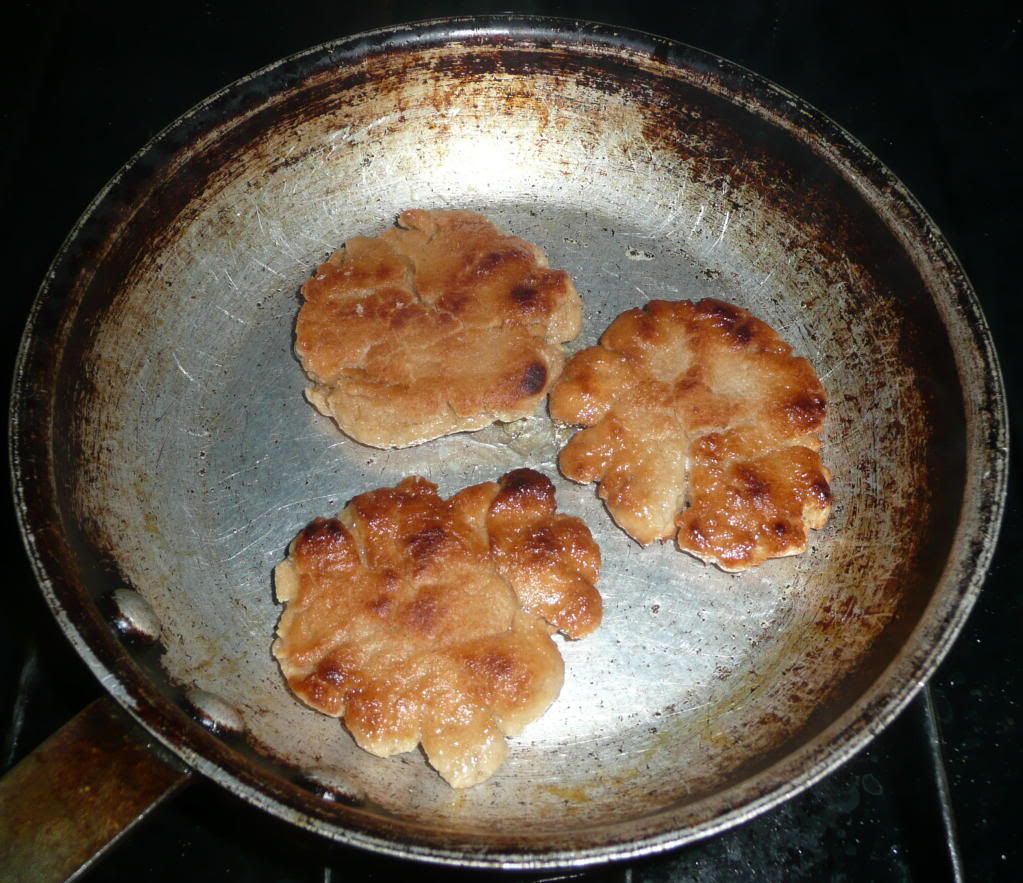 |
| Barley cakes in the pan |
These round quick breads have an earthy, satisfying taste. Barley flour is available in many natural food stores and on line.
2 cups barley flour
½ tsp. salt
1 Tbs. olive oil
¾ cup of warm water (90-100 degrees)
2 Tbs. vegetable oil plus additional as needed
In a large bowl, mix the flour and salt. Drizzle in olive oil and water, mixing continually. Continue to mix (or use hands) until a dough forms. Working with your hands, knead the dough in the bowl for 2 minutes until smooth. Cover with damp cloth and let rest 30 minutes.
Separate dough into 8 balls then flatten and pat each into a rough disk about 2-2 ½ inches in diameter and about ¼ to ½ inch thick.
Heat vegetable oil in a heavy fry pan over medium high heat. Fry cakes 1-2 minutes on each side, adding additional oil as needed, until lightly browned on both sides and cooked through.
Yogurt and Honey
Serves 4
Because of Jewish dietary laws, this recipe uses non-dairy yogurt, but if you'd like substitute regular yogurt. To keep it vegan, use the non-dairy and drizzle with maple or date syrup instead of the honey.
3 cups non-dairy vanilla yogurt (soy milk or coconut milk for example)
¼ cup honey
¼ cup chopped dates
¼ cup chopped walnuts
¼ cup chopped mint
Place about ¾ of a cup of yogurt in each serving dish. Drizzle each serving with the honey, sprinkle with ¼ of the dates and chopped nuts and scatter ¼ of the mint over top.
Monday, October 18, 2010
Boo Appetit -- Pumpkin and Other Goodies for the Season
We like our fright with a bit of delight over here at Blog Appetit, so here's a round up of pumpkin and other Halloween appropriate food. From pumpkin pies to pumpkin-based main courses to caramel and candied apples, we have lots of options for a spooktacular holiday.
 This tamale-stuffed pumpkin would work well for Day of the Dead parties as well as for Halloween repasts. I used some of Primavera's wonderful gourmet tamales, but you could use any kind of cheese or, better yet, cheese and chile, tamale.
 Blog Appetit offers up several kinds of pumpkin pies for your eating pleasure. Try this low-fat pumpkin pie variation for all the traditional treat with a bit less of the tricks. For something a bit different, try this pumpkin and date filo tart. It's super easy to make, is non-dairy and is deliciously different than the traditional pumpkin pie. That tart is shown at left. These pumpkin mini-tarts use individual ginger snaps for their crusts and a petite and neat to eat.
 I used butternut squash when I made this sweet-and-sour cabbage soup, but pumpkin would work just as well. In fact you can use pumpkin pretty much interchangeably with butternut squash in most recipes. Want to learn more about how to select and prepare pumpkins, go to pumpkin boot camp and learn the basics.
 I've made a lot of sautes using pumpkin or butternut squash. One saute was inspired by what I could find in the farmer's market one winter day. This Moroccan inspired chicken, chickpeas and pumpkin dish (pictured) is great served over couscous. I also have a killer chipotle, pumpkin and turkey chili you should try.

 My husband and kids think a caramel apple rules, while an old-fashioned candied apple makes me drool. Unfortunately, most of you agree caramel apples are best. In an informal poll I hosted on Blog Appetit, caramel apples were the clear winner. The caramel apple at left was made according to the directions on the back of a package of Kraft's caramels. My devilishly good candied apples feature the a bit of cinnamon heat from the candies used to give the coating its color and taste.
Friday, October 15, 2010
The Oven-Roasted Garlic Fries that Won the Division for the San Francisco Giants

(Oh, and the garlic fries are probably the main reason I love going to AT&T Park. I even get them when I go to hear the San Francisco Opera's free simulcast every year.)
Oven-Roasted Garlic Fries
Serves 4
These fries could be called twice-cooked garlic fries. The double cooking gives them a crunchy crust and rustic appeal. Not a garlic fan? Skip the garlic (and parsley if you want), the fries will be almost as good.
I leave the peels on the potatoes because we enjoy how the bits and pieces that separate get nice and crunchy. (And speeds preparation time). Feel free to use peeled potatoes if you prefer.
 |
| Go Garlic Fries! Noah at AT&T Park a few years ago |
1/2 cup olive oil, plus additional for baking pans
Salt to taste
8 cloves garlic, minced
1/4 cup chopped parsley
Scrub the potatoes, but do not peel. Slice each potato in half so you have two long sections. Slice each of those sections into four long pieces. Boil in salted boiling water until almost tender. Drain well. Don't worry if the potatoes have lost a bit of their shape or the skins have separated. Oil 2 large baking pans or trays. Put 1/2 cup of olive oil in a large bowl, add some salt if desired, and toss with cooked potato. Spread the coated potatoes out in a single layer on the baking trays. Bake in a preheated 475 degree oven, turning occasionally until the potatoes are browned and crisp. (This can take anywhere from 30-50 minutes, so keep a close eye on them.) Remove from oven and while still very hot toss with salt to taste, minced garlic and chopped parsley.
Wednesday, October 13, 2010
It's My Blog-o-versary and I'll Get a New Domain Name if I Want To!
 Yes, it's been five years since Blog Appetit was launched with its first post (Testing.Testing.). Some things haven't changed, like my commitment to original recipes, food education, celebrating locally sourced food, attempting to grow as a writer and recipe developer, trying to improve my photos, exploring new cuisines, trying to put ethnic food in a cultural or at least personal context and promoting food justice.
Other things have changed a lot. My first blog description was Food Views, Muse and News You Can Use (or something like that), replaced by Read. Think. Eat. I like to think I got it right on the third try: Cooking Local. Eating Global. (If you don't know what I'm referring to, it's the line that appears right below the words Blog Appetit in the header.)
Another big change is that as of today, I'm publishing at my own custom domain. The new web address is http://www.clickblogappetit.com/. If you link to me over at http://clickblogappetit.blogspot.com/, don't worry, everything should refer. (Please note that since it took me hours and hours today to get this set up right and there have been random glitches, so there is always a chance the domain could end up off line a bit as everything gets jiggered into place. If that happens, check back on the blogspot address until the snafu is corrected.) Just found a glitch -- my blog search isn't functioning correctly yet.
Another part of my blog-o-versary celebration is the beginning of a special project about how families and individuals from around the U.S. and elsewhere celebrate Shabbat. If you would like to participate in that, please read this post for more information.
Oh, and a special shout out to my friends from Blogher Food 2010 (particularly Copykat) who convinced me to take a deep breath and get my own domain.
Here's a few of my favorite blog posts. Give them a read and let me know what you think. Thanks for clicking in for these past five years. I look forward to many more.
A trip back in time in Tombstone AZ and a buffalo burger recipe
The food of Jewish Shanghai and a sweet and sour fish recipe
Jewish delis -- they weren't just about the food -- and a chopped liver recipe
-----------------------------
Photo by Bonnie Burt
Thursday, October 07, 2010
Some Advice for Food Writers and Bloggers from Will Write for Food's Dianne Jacob

The new edition is subtitled "The Complete Guide to Writing Cookbooks, Blogs, Reviews, Memoir, and More" and is fully updated. It includes information on blogging, electronic publishing and other topics that weren't very mainstream five years ago when the book was first published. Jacob said other topics needed an updating since technology and the changing nature of food media have affected the market for food writing.
Here are some points Jacob made at her talk and during the question and answer session afterward.
Restaurant reviewing has changed because of sites such as Yelp and Chowhound that allow the customer to review and rate his or her experience. It also widens the kinds of restaurants reviewed since the sites are not just for the trendy or upscale establishments.
 |
| Jacob at 9.28.10 talk at Book Passage |
Freelance writing has changed. There is less demand since many of the traditional sources such as magazines have declined and those that have survived are selling fewer ads so they have fewer pages for editorial. Another trend is to shorter stories. There is also pressure on bloggers to contribute posts and even articles for the "exposure" rather than for pay, which drives down freelance rates.
"You can't just want to write a cookbook, you need to have a national platform," Jacob says. While publishers were always interested in cookbook authors that had a built in audience, now it is almost obligatory. A successful blog is one way to build that platform. "You have to become a somebody before you write the book."
Cookbook authors need to know how to promote their own work. "Publishers are insisting you are in charge of sales of your book," Jacob says.
The bar has been raised for food bloggers. It not just about the food. In addition to strong writing and good recipes, you need to be a photographer, marketer as well as understand a host of technical issues.
Print writers have to increase their visibility. Create a blog if you don't already have one. If you have a cookbook out, your blog should mirror that.
For more on this topic, check out Jacob's Will Write for Food blog and her website. Going to BlogHer Food 2010? Jacob will be moderating the panel on storytelling.
--------------------------
Photo credit of book cover: Amazon
--------------------------
Photo credit of book cover: Amazon
Friday, October 01, 2010
Dine Out for Meals on Wheels and Help Feed Bay Area Seniors

Restaurants throughout San Francisco and Alameda, Contra Costa, Marin, San Mateo, Santa Clara, and Solano counties are participating. Go to http://www.dineoutnow.org/ to see the complete list of participating restaurants. Use that link to also directly donate to Meals on Wheels or request that your favorite restaurant participate in the event. (The site also offers links to the participating restaurants so you can check out menus and hours.)
Among the list of participating restaurants is a number in San Francisco and Alameda County that I have been to and enjoy. In San Francisco, these include the Grand Cafe, Gaylord's and The Elite Cafe. You can see the other participating SF restaurants here. In Alameda County, I've eaten at Ajanta, Dopo, Italian Colors and Speisekammer. You can see the complete list here. There are plenty of of other offerings throughout the Bay area.
For more information, call (888) 716-3669 and or email info@dineoutnow.org
If you know someone who would benefit from being a Meals on Wheels client in the Bay area or elsewhere in the U.S. or would like to support your local area Meals on Wheels, please click here to find an agency near you.
------------------
Graphic credit: Dine Out Now
Sunday, September 26, 2010
Fig-Almond Tart in Cornmeal-Olive Oil Crust Adds Up to Harvest Time Treat

Figs. Jammy with just a bit of lemon, vanilla and sugar.
Almond paste. Smooth, nutty, slightly sweet and wonderful.
Cornmeal and olive oil crust. Crumbly, earthy and a bit hearty.
Put these elements together and you have one of the best things I put in my mouth this year. The textures, tastes and just plain deliciousness made one piece not enough, even without the gilding of whipped cream or vanilla bean ice cream. Plus the crust is very easy to mix and just pat into place (no rolling out needed). Oh, and this goodie is vegan.
The recipe was developed for my j. weekly column. To read that and to see how it fits into the fall harvest celebration of Sukkot, please go here.
Fig Tart with Cornmeal-Olive Oil Crust
Serves 8
1 lb. fresh black figs, quartered
2 Tbs. lemon juice
1 tsp. grated lemon zest
1/8 tsp. vanilla extract
½ cup sugar, divided
1 cup flour
½ cup yellow cornmeal
¼ tsp salt
½ cup extra virgin olive oil
10-oz. can almond paste
Put figs, lemon juice and zest, vanilla and half the sugar in sauce pan over low heat. Cook, stirring occasionally, until thick and jammy, 25-30 minutes.
Preheat oven to 425 degrees. Mix flour, cornmeal, salt and remaining sugar in bowl. Stir in oil. Mix thoroughly with hands until dough comes together. Press evenly into bottom and sides of a 9” tart pan. Prick all over with fork. Bake for 15-18 minutes until crust is lightly browned. (If crust puffs up as it cooks, prick again.) Let cool. Pat almond paste into bottom of tart. Top with cooked figs.
Note: I used Love'n' Bake's almond paste for this recipe and I do recommend it. I have had a long history of using Love'n Bake products (and receiving an occasional sample). Please see my posts on pistachio tart and king cake.
Friday, September 24, 2010
A Taste of Jewish Shanghai Past -- Sweet and Sour Memories (and Recipe)
There is something about China and the Jews.
Maybe it has to something do with a reverence for education, a shared sense of being an outsider, or just the appreciation many U.S. Jews have of growing up eating moo moo gai pan, but the stories of long assimilated Keifeng Jews and the more recent Jewish communities in Harbin and Shanghai attract us as much as the promise of egg fu young or even kung pao chicken.
The stories of lives led and a culture lost have an appeal that affects Jews beyond those whose heritage has been touched by these places, which includes communities of Russian Jews who fled pograms and poverty and later the Russian revolution through Siberia and the Trans-Siberian railroad into Harbin, Iraqi and Indian-Iraqi Jews leading what has often been depicted as idealized colonialized life in pre-World War II Shanghai or the grimmer realities of hunger, internment and uncertainity faced by Holocaust refugees in a Shanghai ghetto.
Recently at the Jewish Community Center of the East Bay, in Berkeley, CA, Inna Mink and Dianne Jacob got to explore their families' Chinese heritage and food memories and we got a taste literally and figuratively of a lost world, with local restaurants supplying some typical Shanghaiese foods for tasting. The event was co-sponsored by the Asian Culinary Forum.
The evening, tied to the closing of the Shanghai exhibit at San Francisco's Asian Art Museum, was supposed to be about food, but as usual it is hard to divorce the food from its place in memory, family, culture, society, economics and identity.
Mink's grandparents left the pogroms of Russia for Harbin, what was then essentially a Manchurian Chinese shtel without plumbing or much of anything else. It's only recommendation was that it was not Russia and they felt safe. When Mink was two, her parents thought there would be more economic opportunity in Shanghai and moved 1,000 miles to the south. The lived in the French Concession, an upper class European section of a city divided by race, class and economics thanks to the Opium Wars and its position on the edge of China on the Yangtze River.
Mink is a grandmotherly woman who came to the U.S. after WWII, but her face softens, her smile broadens and a playful young woman peeks out from under her auburn bangs when she talks about growing up in Shanghai in general and eating there in particular. "The food was spectacular in Shanghai," she said, almost with a sigh.
She and her mother did not cook nor did any in their set. Servants were plentiful. Food in the home was in the Russian style with beef stroganoff and chicken cutlets called kotleta po-kievksy oozing butter. Jewish style food and kosher considerations (such as mixing meat and milk products) were only seen on the table during the High Holidays and Passover.
Mink and her family mingled with her father's Chinese factory managers and customers, sometimes eating in their homes. Once a month they would visit their favorite Chinese restaurant Sun Ya, on what Mink called Bubbling Well Road (or Nanking) ; a restaurant whose food was so defining for her she has saved a menu from it. (The Cantonese-style restaurant is still in business and is now known as Xinya.)
The family was Jewish, ate Russian food and sent Mink to a French school, but even now it is the Chinese part of her life that she feels has shaped her. The food is still compelling and the pull of Chinatowns and Asian restaurants is strong. Food is the only memory from that time she can still taste, but the time and place have marked her and made China part of her heritage.
Jacob's story differs in many aspects from Mink's. Her family was from a Baghdadi Jewish background. These were Mitzrachi, or Eastern Jews, with roots in Iraq and in India (where many Iraqi Jews settled before they came to Shanghai.) The Iraqi-Indian Iraqi community began settling in Shanghai the later half of the 1800s. By World War II it was made up of about 500 families who developed diverse Jewish organizations as well as built up the famous waterfront Bund and settled in the International concessions. Trade and business had brought them to Shanghai. Orthodox and observant, for them events based in the synagogue and the home were of primary importance, but many went out for drinks, shows and other nightlife. As with Mink, servants ruled the kitchen and most of the Jewish women did not cook. The household cooks made British, Chinese foods, and dishes reflecting the Jews' Iraqi and Indian roots with adaptations for local food ways such as fresh bamboo shoots in the stew and rice flour dumplings instead of semolina.
"Usually it was an American breakfast, a British luncheon, an Iraqi-style tea with pastries and fruit and supper was Iraqi or Indian Jewish food," she said.
Jacob was born in Canada after her parents had immigrated in 1949, but she grew up in a home that identified strongly as Chinese. Her parents spoke to Jacob and her sister in the Shanghai dialect (or in Arabic), ate with chopsticks and tried to adapt New World ingredients and Chinatown pantry items into the remembered foods of their past and a connection to what had once been their home. Jacobs recalls her mother's version of spaghetti, a dish her mom had never eaten before, made with copious amounts of onions and black pepper and served with grilled chicken livers. Jacobs was in college before she had pasta with meatballs, tomato sauce and basil. She described the dish to her astonished mother who thought the combination totally unappetizing.
And once a month the family would eat out at a local Chinese restaurant, where, according to Jacob, Jewish "amnesia" would set in, and the Jewish dietary laws would be forgotten for a taste of the past and a connection with a life and identity they had left behind.
Growing up focused on the food of a country half a world away left an impact on Jacob.
"I'd say I feel very Asian identified. I'm very comfortable with anything Chinese, particularly food."
The families of Mink and Jacob had very different experiences after the Japanese occupied the city in 1937. Jacob's father's family, who had Iraqi citizenship, was considered stateless and was not allowed to work. One uncle made peanut butter and sold it on the street to survive. Her mother's family held British papers and was interned for five years across the river in an encampment in the then rural Pudong area. There was never enough food and what there was often spoiled and full of bugs.
As a Russian, Mink's wartime experiences were much less harsh. There were some travel restrictions and shortages of such things as oranges, butter, eggs and gasoline, but they "didn't have to give up much," she said.
It was during World War II that the third major group of Jews arrived in Shanghai, refugees from the Holocaust. These were Eastern European Jews many of whom were aided in their flight by visas issued by Japanese and Chinese consular authorities in Poland and Austria. The Japanese eventually moved many of the 20,000 refugees into a three-quarters of a square-mile ghetto in the Honkou district (sometimes spelled Honkow) without first moving out the area's 200,000 Shanghai residents in what already was an overcrowded and run down area. Restrictions on the refugees increased as the war progressed, but the Japanese governor never acceded to the Nazi demands to hand over the Jews.
Neither Jacob or Mink had Honkou experiences to share, but several audience members had family members who were restricted to the ghetto and they spoke about the hardships, lack of food and rationing that their loved ones endured. One woman told of how her Austrian grandmother made Viennese pastries and sold them in coffee houses to help provide for her family.
There were no recipes given out that night and both speakers said they knew of no cookbook that could capture the special food that their families had eaten in Shanghai. (One audience member commented "recipes were passed down from one generation to another like the Torah.") Most if not all the Jews of that period left China once the Communists came to power. The Jews in China today are mostly Israeli and other consulate and embassy personnel, Chabad emissaries, expatriate executives and other foreign workers.
China itself seems to appreciate the richness and diversity Jews brought to Shanghai and has restored some buildings important to Jewish heritage including one of the Eastern European Jewish communities' synagogues and put in a Jewish museum. The exhibit is mostly photo and text panels and focuses on the Holocaust refugee experience, though, there is not much tangible evidence of the community itself except for on the second floor where an old sewing machine and other goods left behind by Jewish emigres are displayed.
There is almost no Judaica in the temple building, but there was a mezzuah (prayer scroll in a small container) hung on the door frame. When I was there, a young Chinese security guard came up to me, pointed to it with pride and in halting English told me it was something the Jews used to touch when they came into the building. I didn't explain to him that I knew all about these door hangings, I just thanked him. Then I reached up, touched it and kissed my fingers.
I remembered that moment the other night as Mink and Jacob were sharing their memories. I remember feeling connected to those Jews so long ago in such an exotic place by the universal Jewish act of touching a mezzuah. As Mink and Jacob talked that memory came back to me and I though maybe for me as well as others the appeal of Jews in China was that even in what to us is an exotic setting we still had that connection of ritual and meaning that we could share, even across time. And for Mink, Jacob and others with Harbin and Shanghai in their past, the food they ate was as an important link to them as any ritual, photograph or memory. It was a way to define their identity. Their lives in China were multicultural and multilingual. (Mink's family spoke Russian, Chinese, English and French. Jacob's family spoke Arabic, English and Chinese.) Perhaps they only became aware of themselves as being an Asian Jew after their families had left China, but it is now a haunting part of who they are.
-----------------
 |
| The Bund, once center of Shanghai Jewish life, today |
Maybe it has to something do with a reverence for education, a shared sense of being an outsider, or just the appreciation many U.S. Jews have of growing up eating moo moo gai pan, but the stories of long assimilated Keifeng Jews and the more recent Jewish communities in Harbin and Shanghai attract us as much as the promise of egg fu young or even kung pao chicken.
The stories of lives led and a culture lost have an appeal that affects Jews beyond those whose heritage has been touched by these places, which includes communities of Russian Jews who fled pograms and poverty and later the Russian revolution through Siberia and the Trans-Siberian railroad into Harbin, Iraqi and Indian-Iraqi Jews leading what has often been depicted as idealized colonialized life in pre-World War II Shanghai or the grimmer realities of hunger, internment and uncertainity faced by Holocaust refugees in a Shanghai ghetto.
Recently at the Jewish Community Center of the East Bay, in Berkeley, CA, Inna Mink and Dianne Jacob got to explore their families' Chinese heritage and food memories and we got a taste literally and figuratively of a lost world, with local restaurants supplying some typical Shanghaiese foods for tasting. The event was co-sponsored by the Asian Culinary Forum.
The evening, tied to the closing of the Shanghai exhibit at San Francisco's Asian Art Museum, was supposed to be about food, but as usual it is hard to divorce the food from its place in memory, family, culture, society, economics and identity.
Mink's grandparents left the pogroms of Russia for Harbin, what was then essentially a Manchurian Chinese shtel without plumbing or much of anything else. It's only recommendation was that it was not Russia and they felt safe. When Mink was two, her parents thought there would be more economic opportunity in Shanghai and moved 1,000 miles to the south. The lived in the French Concession, an upper class European section of a city divided by race, class and economics thanks to the Opium Wars and its position on the edge of China on the Yangtze River.
Mink is a grandmotherly woman who came to the U.S. after WWII, but her face softens, her smile broadens and a playful young woman peeks out from under her auburn bangs when she talks about growing up in Shanghai in general and eating there in particular. "The food was spectacular in Shanghai," she said, almost with a sigh.
She and her mother did not cook nor did any in their set. Servants were plentiful. Food in the home was in the Russian style with beef stroganoff and chicken cutlets called kotleta po-kievksy oozing butter. Jewish style food and kosher considerations (such as mixing meat and milk products) were only seen on the table during the High Holidays and Passover.
Mink and her family mingled with her father's Chinese factory managers and customers, sometimes eating in their homes. Once a month they would visit their favorite Chinese restaurant Sun Ya, on what Mink called Bubbling Well Road (or Nanking) ; a restaurant whose food was so defining for her she has saved a menu from it. (The Cantonese-style restaurant is still in business and is now known as Xinya.)
The family was Jewish, ate Russian food and sent Mink to a French school, but even now it is the Chinese part of her life that she feels has shaped her. The food is still compelling and the pull of Chinatowns and Asian restaurants is strong. Food is the only memory from that time she can still taste, but the time and place have marked her and made China part of her heritage.
 |
| Mink (left) and Jacobs |
"Usually it was an American breakfast, a British luncheon, an Iraqi-style tea with pastries and fruit and supper was Iraqi or Indian Jewish food," she said.
Jacob was born in Canada after her parents had immigrated in 1949, but she grew up in a home that identified strongly as Chinese. Her parents spoke to Jacob and her sister in the Shanghai dialect (or in Arabic), ate with chopsticks and tried to adapt New World ingredients and Chinatown pantry items into the remembered foods of their past and a connection to what had once been their home. Jacobs recalls her mother's version of spaghetti, a dish her mom had never eaten before, made with copious amounts of onions and black pepper and served with grilled chicken livers. Jacobs was in college before she had pasta with meatballs, tomato sauce and basil. She described the dish to her astonished mother who thought the combination totally unappetizing.
And once a month the family would eat out at a local Chinese restaurant, where, according to Jacob, Jewish "amnesia" would set in, and the Jewish dietary laws would be forgotten for a taste of the past and a connection with a life and identity they had left behind.
Growing up focused on the food of a country half a world away left an impact on Jacob.
"I'd say I feel very Asian identified. I'm very comfortable with anything Chinese, particularly food."
The families of Mink and Jacob had very different experiences after the Japanese occupied the city in 1937. Jacob's father's family, who had Iraqi citizenship, was considered stateless and was not allowed to work. One uncle made peanut butter and sold it on the street to survive. Her mother's family held British papers and was interned for five years across the river in an encampment in the then rural Pudong area. There was never enough food and what there was often spoiled and full of bugs.
As a Russian, Mink's wartime experiences were much less harsh. There were some travel restrictions and shortages of such things as oranges, butter, eggs and gasoline, but they "didn't have to give up much," she said.
It was during World War II that the third major group of Jews arrived in Shanghai, refugees from the Holocaust. These were Eastern European Jews many of whom were aided in their flight by visas issued by Japanese and Chinese consular authorities in Poland and Austria. The Japanese eventually moved many of the 20,000 refugees into a three-quarters of a square-mile ghetto in the Honkou district (sometimes spelled Honkow) without first moving out the area's 200,000 Shanghai residents in what already was an overcrowded and run down area. Restrictions on the refugees increased as the war progressed, but the Japanese governor never acceded to the Nazi demands to hand over the Jews.
Neither Jacob or Mink had Honkou experiences to share, but several audience members had family members who were restricted to the ghetto and they spoke about the hardships, lack of food and rationing that their loved ones endured. One woman told of how her Austrian grandmother made Viennese pastries and sold them in coffee houses to help provide for her family.
There were no recipes given out that night and both speakers said they knew of no cookbook that could capture the special food that their families had eaten in Shanghai. (One audience member commented "recipes were passed down from one generation to another like the Torah.") Most if not all the Jews of that period left China once the Communists came to power. The Jews in China today are mostly Israeli and other consulate and embassy personnel, Chabad emissaries, expatriate executives and other foreign workers.
 |
| Ohel Moshe is now a museum |
China itself seems to appreciate the richness and diversity Jews brought to Shanghai and has restored some buildings important to Jewish heritage including one of the Eastern European Jewish communities' synagogues and put in a Jewish museum. The exhibit is mostly photo and text panels and focuses on the Holocaust refugee experience, though, there is not much tangible evidence of the community itself except for on the second floor where an old sewing machine and other goods left behind by Jewish emigres are displayed.
There is almost no Judaica in the temple building, but there was a mezzuah (prayer scroll in a small container) hung on the door frame. When I was there, a young Chinese security guard came up to me, pointed to it with pride and in halting English told me it was something the Jews used to touch when they came into the building. I didn't explain to him that I knew all about these door hangings, I just thanked him. Then I reached up, touched it and kissed my fingers.
I remembered that moment the other night as Mink and Jacob were sharing their memories. I remember feeling connected to those Jews so long ago in such an exotic place by the universal Jewish act of touching a mezzuah. As Mink and Jacob talked that memory came back to me and I though maybe for me as well as others the appeal of Jews in China was that even in what to us is an exotic setting we still had that connection of ritual and meaning that we could share, even across time. And for Mink, Jacob and others with Harbin and Shanghai in their past, the food they ate was as an important link to them as any ritual, photograph or memory. It was a way to define their identity. Their lives in China were multicultural and multilingual. (Mink's family spoke Russian, Chinese, English and French. Jacob's family spoke Arabic, English and Chinese.) Perhaps they only became aware of themselves as being an Asian Jew after their families had left China, but it is now a haunting part of who they are.
-----------------
Here are some typical Shanghai recipes for drunken chicken, vegetarian goose and sweet and sour lotus root from the Asian Culinary Forum site. the recipes are by Chef Nei Chia Ji of Jai Yun and were prepared for an event at the Asian Art Museum in conjunction with the culinary forum as part of the programming centered around the museum's Shanghai exhibit.
The 1935 menu from Mink's favorite restaurant, Sun Ya, is almost more like an informational brochure about Cantonese food than a menu. Sweet and sour dishes seemed to be fairly popular, including Mandarin fish, called the "famous fish of Shanghai." Since I learned a version of sweet and sour sauce in my Shanghai cooking class and later adapted the recipe for fish, I include that recipe here.
Sweet and Sour Fish
Serves 4 or 6 as part of a multi-course Chinese-style meal
The ketchup in the recipe is totally authentic, much to my surprise. I haven’t done the research so I don’t know if sweet and sour sauce began life in this country (perhaps as an adaption of a traditional dish or a unique one based on Western food availability) and migrated there or a traditional one that was adapted as Western ingredients made their way to China.
Note: I used a combination of regular white distilled vinegar and Chinese black rice vinegar (I used one third black rice vinegar), which gave the dish a nice taste and toned down the bright red sweet and sour color (as does the soy sauce). You could also try apple cider vinegar instead of the Chinese black rice vinegar or just using all white distilled vinegar. Avoid the Japanese rice vinegars; they are too mild to give the zing we associate with sweet and sour sauce.
Sauce
4 1/2 tablespoons sugar
4 tablespoons vinegar (see note above)
2 teaspoons soy sauce
4 tablespoons tomato ketchup
1 cup water
¼ teaspoon salt
Fish
1 ½ pounds thickish filets of rock cod, cod, halibut, pretty much any non-oily white fish
1 teaspoon salt or to taste
2 eggs, beaten
3 tablespoons of cornstarch
Canola or other vegetable oil for deep frying
Stir Fry
4 cloves garlic, thinly sliced (about a heaping tablespoon)
2 green onions, white and light green parts, thinly sliced (about 2 tablespoons)
2 medium bell peppers (I used one green and one red), cut into 1” or so pieces
1 tablespoon cornstarch dissolved in 1 tablespoon water
8 ounces of pineapple cut in 1” cubes, (fresh or drained canned)
Make the sauce first in either the wok or another pan.
Combine all the sauce ingredients in the pot. Heat over medium heat, stirring occasionally, until the sugar is dissolved and the mixture is well combined. Taste and correct the seasoning, adding more vinegar, ketchup and/or salt until you have the preferred balance of sweet vs. sour. Set aside off the heat. (If you have used the wok for the sauce, thoroughly clean and dry it before frying fish.)
Prepare fish. Rinse and pat fish dry. Sprinkle fish with salt. Cut into approximately 1 ½ inch cubes or chunks. In a large enough bowl to hold all the fish cubes, combine eggs and cornstarch until well mixed. Add the fish cubes and toss to coat thoroughly.
Heat oil for deep frying in the wok or another deep, large pan, such as a chicken fryer or sauté pan. Heat oil until is medium to very hot (about 375 degrees F). (To see if the oil is ready, drop a bit of batter if it immediately sizzles and begins to brown, the oil is ready.) Add a few fish cubes at a time, frying until golden brown and cooked through and removing to drain on a plate. Continue until all the fish cubes are fried. Set aside.
Properly dispose of the oil, leaving about 2 tablespoons in the wok or pan. Strain out any left over fried bits with a slotted spoon or skimmer. Heat oil until very hot. Add the garlic and stir fry, being careful not to burn it. Add the scallions and the pepper pieces and stir fry until the pepper pieces begin to soften. Add in reserved sauce and bring to a boil. Slowly drizzle in the cornstarch mixture, stirring until it is well combined and the sauce is thickened. It should still be liquid, but not runny or thick and should coat the back of the spoon. Stir in pineapple chunks and the fish. Mix to evenly distribute sauce. Serve with rice.
-----------------------------
About the photos: Shanghai and stir fry photos taken by me in 2008.
The 1935 menu from Mink's favorite restaurant, Sun Ya, is almost more like an informational brochure about Cantonese food than a menu. Sweet and sour dishes seemed to be fairly popular, including Mandarin fish, called the "famous fish of Shanghai." Since I learned a version of sweet and sour sauce in my Shanghai cooking class and later adapted the recipe for fish, I include that recipe here.
 |
| Sweet and sour in Shanghai class |
Serves 4 or 6 as part of a multi-course Chinese-style meal
The ketchup in the recipe is totally authentic, much to my surprise. I haven’t done the research so I don’t know if sweet and sour sauce began life in this country (perhaps as an adaption of a traditional dish or a unique one based on Western food availability) and migrated there or a traditional one that was adapted as Western ingredients made their way to China.
Note: I used a combination of regular white distilled vinegar and Chinese black rice vinegar (I used one third black rice vinegar), which gave the dish a nice taste and toned down the bright red sweet and sour color (as does the soy sauce). You could also try apple cider vinegar instead of the Chinese black rice vinegar or just using all white distilled vinegar. Avoid the Japanese rice vinegars; they are too mild to give the zing we associate with sweet and sour sauce.
Sauce
4 1/2 tablespoons sugar
4 tablespoons vinegar (see note above)
2 teaspoons soy sauce
4 tablespoons tomato ketchup
1 cup water
¼ teaspoon salt
Fish
1 ½ pounds thickish filets of rock cod, cod, halibut, pretty much any non-oily white fish
1 teaspoon salt or to taste
2 eggs, beaten
3 tablespoons of cornstarch
Canola or other vegetable oil for deep frying
Stir Fry
4 cloves garlic, thinly sliced (about a heaping tablespoon)
2 green onions, white and light green parts, thinly sliced (about 2 tablespoons)
2 medium bell peppers (I used one green and one red), cut into 1” or so pieces
1 tablespoon cornstarch dissolved in 1 tablespoon water
8 ounces of pineapple cut in 1” cubes, (fresh or drained canned)
Make the sauce first in either the wok or another pan.
Combine all the sauce ingredients in the pot. Heat over medium heat, stirring occasionally, until the sugar is dissolved and the mixture is well combined. Taste and correct the seasoning, adding more vinegar, ketchup and/or salt until you have the preferred balance of sweet vs. sour. Set aside off the heat. (If you have used the wok for the sauce, thoroughly clean and dry it before frying fish.)
Prepare fish. Rinse and pat fish dry. Sprinkle fish with salt. Cut into approximately 1 ½ inch cubes or chunks. In a large enough bowl to hold all the fish cubes, combine eggs and cornstarch until well mixed. Add the fish cubes and toss to coat thoroughly.
Heat oil for deep frying in the wok or another deep, large pan, such as a chicken fryer or sauté pan. Heat oil until is medium to very hot (about 375 degrees F). (To see if the oil is ready, drop a bit of batter if it immediately sizzles and begins to brown, the oil is ready.) Add a few fish cubes at a time, frying until golden brown and cooked through and removing to drain on a plate. Continue until all the fish cubes are fried. Set aside.
Properly dispose of the oil, leaving about 2 tablespoons in the wok or pan. Strain out any left over fried bits with a slotted spoon or skimmer. Heat oil until very hot. Add the garlic and stir fry, being careful not to burn it. Add the scallions and the pepper pieces and stir fry until the pepper pieces begin to soften. Add in reserved sauce and bring to a boil. Slowly drizzle in the cornstarch mixture, stirring until it is well combined and the sauce is thickened. It should still be liquid, but not runny or thick and should coat the back of the spoon. Stir in pineapple chunks and the fish. Mix to evenly distribute sauce. Serve with rice.
-----------------------------
About the photos: Shanghai and stir fry photos taken by me in 2008.
A Word to My Readers
If you were reading the post on the food memories of Shanghai Jews on Blog Appetit's front page (above this) and wondering why the heck I didn't add a jump or break it's because some code in the program kept messing with the formating and I lost all spacing. If you have any idea what I need to do to fix it, please let me know. I think it's because I put a jump break in and moved it and it left some sticky residue in the code, but I am just guessing based on trial and error. Leave me a comment or email me at clickblogappetitDOTgmailDotcom if you can be of more assistance on this than blogger help or forums was!
Subscribe to:
Posts (Atom)